
Best Custom Home Builder Website Examples

Article by
Harry Stanley III
Harry Stanley III is a construction marketing strategist and fractional CMO at H&A Marketing. He has helped construction companies grow through website strategy, SEO, paid advertising, branding, lead generation, CRM systems, and professional content. His past work includes helping Meraki Solar generate an additional $3.7 million in revenue in his first year and supporting American Builders as a fractional CMO. Today, Harry works directly with custom home builders and construction companies to build marketing systems designed to generate qualified leads and measurable growth.
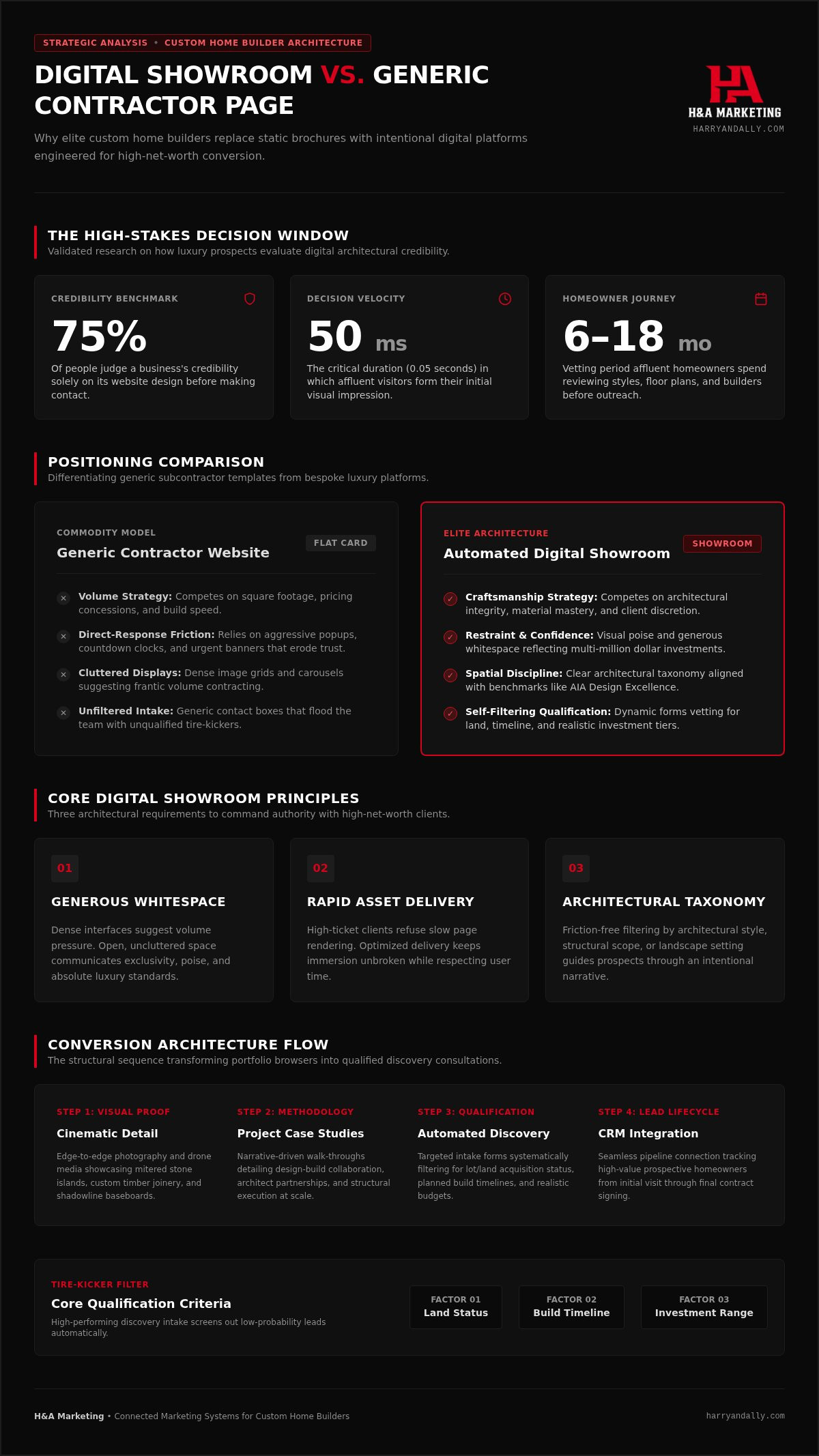
Research shows that 75% of people judge a business's credibility based on its website design, forming that critical first impression in just 50 milliseconds. You pour relentless precision into every luxury residence you construct, but if your pages load slowly or fail to showcase your detailing, affluent buyers assume your field standards are just as sloppy. Studying top custom home builder website examples quickly confirms what premier builders already know: a static digital brochure won't capture multi-million dollar contracts.
Your online presence needs to function as an automated digital showroom that commands respect and filters out tire-kickers before your team ever picks up the phone. In this guide, you'll discover what makes elite builder websites convert high-net-worth visitors into qualified project inquiries. We'll walk through real architectural design principles, high-performing visual portfolio structures, and the key conversion mechanisms that turn web traffic into booked discovery consultations.
Key Takeaways
- Study the best custom home builder website examples to see how elite firms visually separate multi-million dollar craftsmanship from generic contractor templates.
- Structure your project portfolios as comprehensive case studies that walk affluent prospects through your design-build methodology and detailing.
- Implement discovery forms that automatically qualify leads by filtering for land status, build timelines, and realistic project investment ranges.
- Optimize high-resolution architectural imagery and mobile responsiveness to protect conversion rates and deliver a friction-free browsing experience.
- Connect your digital showroom to automated CRM workflows to track high-value prospects from their initial site visit to the contract signing.
What Separates High-Performing Custom Home Builder Websites from Generic Contractor Pages
High-net-worth clients don't hire a luxury builder the way they hire an emergency plumber. If your digital footprint relies on generic trade templates with neon "Call Today!" banners and stock jobsite badges, you immediately signal volume subcontracting instead of bespoke craftsmanship. Elite firms understand that a digital platform must mirror the architectural sophistication of the physical structures they build. When reviewing premier custom home builder website examples, the distinction between a commodity contractor page and an architectural authority becomes obvious within seconds.
Volume residential builders compete on square footage and speed. Bespoke custom builders compete on architectural integrity, material mastery, and client discretion. According to trade data from the National Association of Home Builders, custom residential construction involves complex timelines and specialized project coordination that standard production builders never encounter. Your website must communicate that distinction immediately through deliberate layouts, understated typography, and visual poise.
The Psychology of the Luxury Homeowner Journey
Affluent homeowners operate on extended buying cycles. They spend six to eighteen months vetting architectural styles, floor plans, and builders before initiating contact. Direct-response tactics like aggressive popups, countdown clocks, and urgency-driven forms instantly erode trust with this audience. High-net-worth individuals prioritize risk mitigation and reputation. Before scheduling a discovery consultation, they look for specific trust markers: clear explanations of the design-build workflow, evidence of seamless collaboration with prominent architects, and a transparent project vetting process.
Digital Showroom vs. Basic Business Card
A standard contractor website acts like a flat digital business card with a list of generic services. A high-performing platform serves as an interactive digital showroom. When executed correctly through purpose-built construction web design, the platform guides the visitor through an intentional architectural narrative:
- Generous whitespace: Dense, cluttered layouts suggest panic and volume work, while spacious interfaces convey exclusivity, patience, and luxury appeal.
- Rapid asset delivery: High-ticket clients refuse to wait for unoptimized media; fast load speeds preserve immersion and respect the user's time.
- Intuitive navigation: Clean architectural taxonomy allows visitors to filter custom projects by architectural style, structural scope, or landscape setting without friction.
Studying exceptional custom home builder website examples reveals that restraint is a strategic superpower. By trading frantic pitch tactics for refined digital craftsmanship, you set an authoritative baseline that justifies multi-million dollar residential investments.
Key Visual Anatomy Elements Found in the Best Custom Home Builder Website Examples
Top custom home builder website examples don't rely on chaotic image grids or cluttered sliders. Instead, they apply strict architectural discipline to their digital layouts. Just as rigorous physical builds follow benchmarks like the AIA Framework for Design Excellence, an effective digital platform organizes spatial flow, proportion, and visual hierarchy to reflect elite craftsmanship. A thoughtful custom home builder website design combines curated serif or clean sans-serif typography with generous margins, ensuring the work remains the hero. Reviewing 10 Features Every Custom Home Builder Website Needs outlines how these visual fundamentals protect your brand equity from the moment a page renders.
Cinematic Visual Assets and Drone Media Integration
High-end residential prospects want proof of execution at scale. Edge-to-edge architectural photography allows clients to inspect structural details, like mitered stone islands, custom timber joinery, and shadowline baseboards. Complementing still frames with cinematic drone media grounds the home within its physical environment, capturing topography, mature tree canopies, and waterfront access. Discover how purposeful production elevates client trust in our breakdown on Visual Storytelling: Photo and Video for Home Builders, where composition directly influences perceived build value.
Interactive Floorplans and Project Story Case Studies
Generic galleries leave prospects guessing. High-converting portfolio pages structure each build as an in-depth case study. Rather than displaying detached photos, top builders present a cohesive narrative that guides the homeowner through the design-build experience:
- The Site Challenge: Explain complex grading hurdles, zoning constraints, or engineering feats that your team solved during pre-construction.
- Architectural Solutions: Detail specific material selections, structural framing decisions, and custom thermal performance envelopes.
- Interactive Floorplans: Provide downloadable schematic layouts so prospects can visualize spatial circulation and room adjacencies.
- Industry Collaborators: Credit the project architect, interior designer, and landscape architect to reinforce your stature among top-tier trade partners.
Transforming static galleries into comprehensive case studies positions your firm as an elite problem solver. If your current portfolio fails to highlight the depth of your craftsmanship, the team at H&A Marketing can help refine your digital showroom to match your field standards.
Conversion Architecture: Turning Luxury Portfolio Traffic into Qualified Inquiries
Generating web traffic means very little if your inbox fills up with inquiries for minor deck repairs or detached garages. Generic marketing advice often insists that shorter forms yield higher conversion rates. While a simple two-field form might work for an emergency tradesman, it damages a bespoke builder. Sifting through unqualified leads wastes dozens of estimating hours each month. When analyzing top custom home builder website examples, you'll find that elite builders intentionally introduce strategic friction to pre-qualify prospects before initiating a consultation.
An effective luxury platform acts as a digital gatekeeper. By pairing deliberate inquiry paths with targeted lead generation for construction companies, you attract serious homeowners who respect your process and possess the financial capacity to build at your standard.
Designing Frictionless Project Intake Questionnaires
The goal isn't to create an interrogation; it's to deliver an elevated discovery experience. Multi-step forms that guide users through interactive questions feel more like an architectural planning session than a generic contact page. High-converting intake forms focus on specific operational qualifiers:
- Land Status: Do they already own a homesite, have a lot under contract, or require assistance with land acquisition?
- Architectural Plans: Are they starting with an initial concept, working with an independent architect, or holding permit-ready construction drawings?
- Project Timeline: When are they expecting to break ground?
- Anticipated Investment: Providing clear minimum budget thresholds immediately filters out budget-mismatched prospects without requiring awkward discovery calls.
Strategic Call-to-Action Placement Across the Experience
Affluent buyers rarely respond to aggressive "Get a Quote" buttons pulsing in the header. Instead, position subtle, contextual calls-to-action throughout the narrative flow of your project case studies. When a prospect finishes reviewing an in-depth waterfront build, invite them to "Discuss Your Architectural Vision" or "Inquire About Upcoming Build Availability."
This approach aligns your call-to-action with their psychological readiness. If you're currently auditing your firm's online lead flow, review our checklist on Choosing a Contractor Website Design Agency: The 2026 Buying Guide to ensure your digital partner understands high-ticket buyer journeys.
Technical Infrastructure: Fast Load Times, Mobile UX, and High-Ticket SEO
High-resolution architectural visuals mean nothing if your site grinds to a halt on a prospect's phone. Research reveals that 53% of mobile visitors abandon a site that takes longer than three seconds to load, with a single second of delay slashing mobile conversions by up to 20%. For luxury home builders, sluggish load speeds don't just elevate bounce rates; they project technical incompetence. The strongest custom home builder website examples pair magazine-quality imagery with an uncompromising technical foundation.
Optimizing High-Resolution Media for Instant Mobile Loading
Custom builders often upload five-megabyte raw photography directly to their media libraries, causing pages to stall. Meeting Google Core Web Vitals thresholds requires a Largest Contentful Paint of 2.5 seconds or less and a Cumulative Layout Shift under 0.1. Achieving this with media-dense portfolios demands aggressive asset optimization:
- Next-Gen Compression: Convert heavy image files into lightweight WebP formats without sacrificing sharpness or color grading.
- Responsive Srcsets: Serve scaled dimensions tailored specifically to the visitor's screen size rather than forcing mobile devices to download desktop-sized assets.
- Edge Delivery Networks: Distribute visual assets across a global content delivery network to eliminate server latency.
Information Architecture for Luxury Construction Search Terms
Broad search terms like "local contractor" or "home builder" attract volume tract inquiries and minor renovation requests. Building a high-value pipeline requires structured keyword silos centered on architectural styles, specialized building methods, and distinct geographic enclaves. Building out dedicated project URLs and style-specific service pages creates targeted entry points for affluent homeowners searching for specific capabilities. Implementing comprehensive SEO ensures your custom projects rank for high-intent search phrases. To evaluate whether your development partner understands these technical requirements, read our guide on Choosing the Best Construction Website Design Agency for 2026.
Audit your custom home builder site speed and search rankings with H&A Marketing
Connecting Your Custom Builder Website to a Unified Marketing System
Even the most striking custom home builder website examples will fail to produce revenue if they sit in isolation. A high-end digital showroom cannot generate contracts without qualified traffic flowing in and structured follow-up systems operating behind the scenes. Treating web development as an isolated, one-off project is where many builders lose momentum. Sustainable pipeline growth happens when your website operates as the central hub of an integrated, connected marketing system.
Disjointed tactics create friction. When your search campaigns, social channels, jobsite media, and website operate in silos, prospective clients receive mixed messages. Unifying high-end visual production, deliberate branding, and technical site architecture ensures every marketing dollar works toward filling your pipeline with serious luxury inquiries.
Automating Discovery Inquiries into Organized CRM Pipelines
When an affluent homeowner completes an in-depth discovery questionnaire, speed and professionalism dictate their impression of your firm. If their project details sit unread in an administrative inbox for three days, their confidence drops. Connecting your digital intake forms directly to CRM pipeline tracking ensures immediate internal notification and structured follow-up:
- Instant Sales Routing: Direct high-budget inquiries to senior project managers based on requested build locations or architectural scopes.
- Automated Nurture Workflows: Deliver a curated portfolio lookbook or a design-build process guide while the prospect awaits their scheduled discovery call.
- Behavioral Tracking: Monitor which project case studies the prospect spent time reviewing so your sales team enters the initial consultation with actionable context.
Transforming Your Web Presence into an End-to-End Asset
High-ticket residential construction requires sustained brand cohesion across every client touchpoint. Your on-site positioning must align seamlessly with your construction branding, while your portfolio pages demand ongoing updates powered by professional video and photo production that captures finished builds and active craftsmanship.
At H&A Marketing, we build connected marketing systems exclusively for custom home builders and construction companies. We coordinate strategy, creative assets, traffic generation, and lead capture under one roof, eliminating the need to manage disconnected vendors. If your current website fails to reflect the caliber of your craftsmanship or leaves your pipeline unpredictable, reach out to discuss your growth strategy or request a comprehensive marketing audit.
Build a Digital Showroom That Matches Your Field Craftsmanship
Studying the top custom home builder website examples proves that an elite digital presence must do far more than display attractive photos. It has to establish immediate architectural authority, highlight bespoke craftsmanship through in-depth project narratives, and systematically pre-qualify high-net-worth inquiries. When you treat your website as an active digital showroom rather than a flat brochure, you protect your estimating resources and elevate your brand positioning.
Sustainable growth requires every component of your marketing to work in harmony. H&A Marketing builds specialized digital marketing and website systems specifically for construction companies and custom builders. We coordinate custom design, professional video, high-ticket SEO, and CRM tracking into one connected marketing system.
Your physical builds demonstrate uncompromised quality on every jobsite. It's time your online presence reflected that same standard of excellence.
Frequently Asked Questions
What essential pages must every custom home builder website include?
Every luxury builder platform requires a curated portfolio of in-depth case studies, a dedicated design-build process page, a firm profile establishing your architectural philosophy, and a structured discovery consultation page. It's also critical to include an architect collaboration page. Affluent prospects want to understand your exact construction methodology and see clear evidence of successful trade partnerships before they ever schedule an initial meeting.
How much does a custom home builder website typically cost to design and build?
Total investment depends heavily on the scope of visual asset production, technical infrastructure, and automated CRM integrations. Rather than treated as off-the-shelf templates, bespoke platforms are custom assets scoped around architectural photography, drone media, advanced filtering, and customized lead qualification workflows. Builders should view their digital presence as an essential business asset designed to protect their pipeline and secure high-value contracts.
How do we showcase luxury custom homes without revealing client privacy or addresses?
Protect homeowner anonymity by naming case studies after architectural themes, land topography, or design motifs instead of street names or family identities. Labeling a project "The Overlook Modern" or "The Coastal Timber Residence" maintains complete discretion. Frame visual assets to focus inward on custom craftsmanship and intentional sightlines rather than identifying neighboring homes, and establish written agreements specifying digital portfolio permissions upfront.
What website platform is best for custom home builders needing portfolio management?
Modern platforms like Webflow or custom WordPress builds provide the best balance of visual design control, content management, and fast hosting. As seen in top custom home builder website examples, the right platform handles heavy media assets efficiently without requiring bloated third-party plugins. It should allow your marketing team to publish detailed case studies easily while maintaining strict mobile responsiveness and sub-second load times.
How can custom home builders prevent low-budget leads from filling out contact forms?
Incorporate deliberate qualification filters directly into your discovery questionnaire. Require visitors to specify their land ownership status, current design phase, and anticipated investment level using a dropdown menu that starts at your firm's baseline project minimum. Stating this clear financial threshold saves estimating time, filters out low-margin inquiries, and immediately signals to high-net-worth clients that you specialize exclusively in bespoke construction.
Why do generic contractor website templates fail for luxury custom home builders?
Generic templates feature cluttered columns, urgent discount banners, and generic service lists tailored for volume repair trades. High-net-worth clients immediately associate those elements with commodity contracting. Reviewing premier custom home builder website examples proves that high-budget sales require generous whitespace, curated typography, and visual poise. A bespoke platform communicates that your field craftsmanship, project management, and detailing are held to an equally uncompromising standard.
How often should a custom home builder update or redesign their website portfolio?
Add new jobsite media and finished project stories continuously as builds achieve completion, ideally each quarter. A complete structural and visual redesign should occur every three to four years. Regular updates ensure your site keeps pace with updated mobile screen dimensions, Core Web Vitals benchmarks, and privacy regulations, while ensuring prospective homeowners always see your most sophisticated work.
