
Construction SEO: Building a High-Intent Lead Engine in 2026

Article by
Harry Stanley III
Harry Stanley III is a construction marketing strategist and fractional CMO at H&A Marketing. He has helped construction companies grow through website strategy, SEO, paid advertising, branding, lead generation, CRM systems, and professional content. His past work includes helping Meraki Solar generate an additional $3.7 million in revenue in his first year and supporting American Builders as a fractional CMO. Today, Harry works directly with custom home builders and construction companies to build marketing systems designed to generate qualified leads and measurable growth.
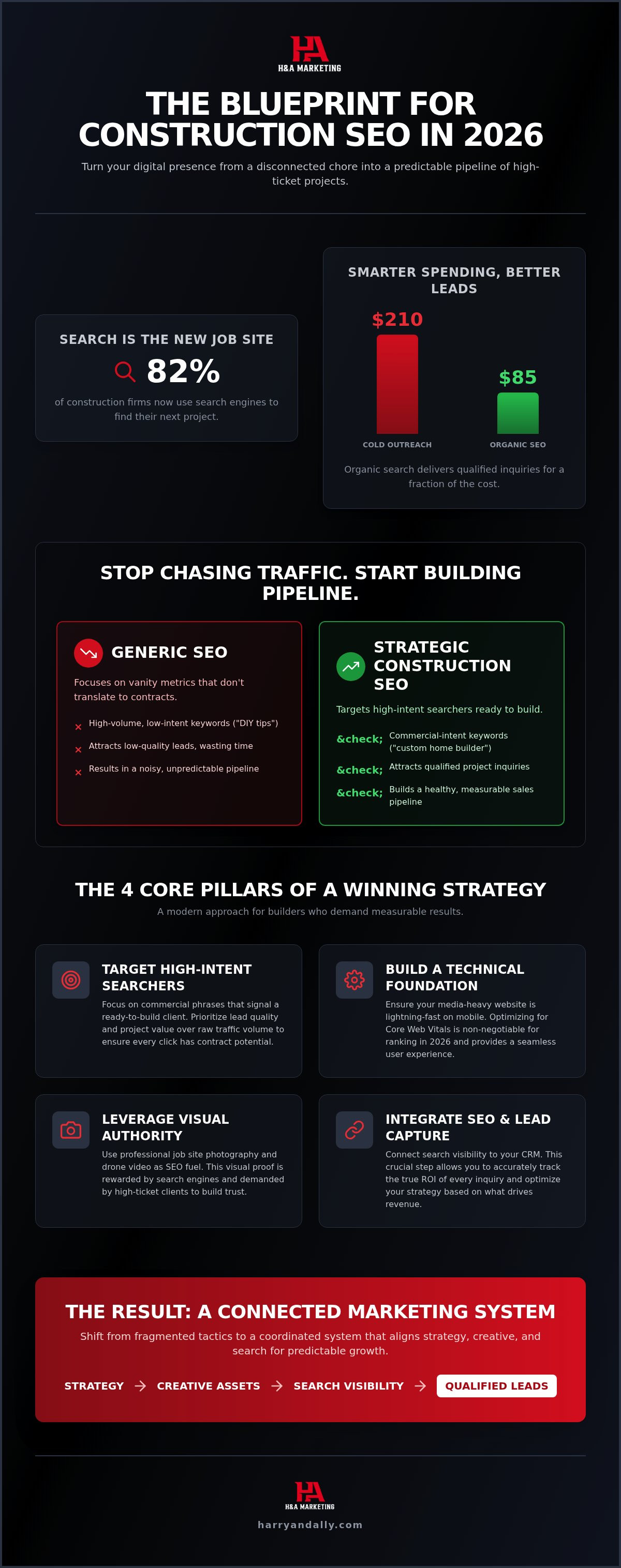
Approximately 82% of construction firms now use search engines to find their next project, yet many builders still pay $210 per lead for cold outreach when organic search could deliver those same inquiries for $85. You've likely felt the frustration of owning a polished website that fails to rank or, worse, attracts low-quality leads that waste your estimating team's time. It's difficult to focus on project delivery when your marketing feels like a disconnected series of chores rather than a reliable system that works while you are on the job site.
Mastering construction SEO in 2026 requires more than just keywords; it demands a strategic alignment of authority, visual proof, and technical precision. This guide will show you how to build a high-intent lead engine that secures high-ticket contracts and ensures your pipeline stays full year-round. We'll explore the methods for dominating local search results, optimizing for AI-driven overviews, and why high-performance custom home builder website design is the foundation of any successful search strategy. You'll gain a clear roadmap for turning digital visibility into measurable project growth through a connected lead generation system.
Key Takeaways
- Prioritize high-intent searchers over vanity traffic metrics to ensure your marketing attracts qualified project inquiries rather than generic leads.
- Build a technical foundation that prioritizes mobile speed and core web vitals, which are essential for ranking heavy media sites in 2026.
- Use professional job site photography and drone video to provide the visual proof that search engines reward and high-ticket clients demand.
- Integrate construction SEO with your CRM and lead capture systems to accurately track the ROI of every search inquiry.
- Shift from fragmented marketing tactics to a connected system that coordinates strategy, creative assets, and search visibility for predictable growth.
Why Generic SEO Fails High-Stakes Construction Firms
Most agencies treat traffic like a trophy. They'll show you charts with upward-trending lines, but your phone isn't ringing with qualified inquiries. This is because generic SEO prioritizes volume over value. For a firm specializing in high-ticket projects, 10,000 visitors searching for "DIY kitchen paint" are useless. Search engine optimization (SEO) should be a focused system designed to capture high-intent searchers within your specific trade.
Effective construction SEO recognizes that you aren't selling a $50 gadget. You're selling a multi-year partnership and a massive financial commitment. This requires a shift from vanity metrics to pipeline health. If your marketing doesn't differentiate between a homeowner looking for a free estimate and a developer looking for a long-term partner, you're wasting your budget. Generic strategies aim for the widest net possible, but value-based strategies for builders aim for the sharpest spear.
The Difference Between Traffic and Qualified Pipeline
Ranking for broad terms like "construction tips" might make your analytics look good, but it won't sell custom homes. High-intent keywords signal a ready-to-build owner. Phrases such as "luxury custom home builder" or "commercial tenant improvement contractor" carry commercial intent. These searchers have already moved past the learning phase and are now in the buying phase. By focusing on high-intent construction SEO, you ensure that every click has the potential to become a contract.
Navigating the Long Sales Cycle of Custom Building
The path from a Google search to a signed contract often takes months. During this time, potential clients are narrowing down their shortlist. SEO supports this journey by positioning your firm as the logical authority long before the first phone call. Educational content that explains project costs, permitting processes, or material selection builds the trust necessary to move prospects from dreaming to bidding. This content supports the decision-making process, keeping your firm top-of-mind as the project moves from a concept to a job site.
Your website acts as the central hub for this trust-building exercise. A high-performance custom home builder website design ensures that when a prospect finds you via search, they see a professional portfolio that matches the quality of your work. By coordinating your search visibility with a strategic lead capture system, you turn casual researchers into predictable project inquiries. This connected approach ensures your marketing supports the sales cycle rather than just adding to the noise.
The Core Pillars of a 2026 Construction SEO Strategy
A robust construction SEO strategy in 2026 requires more than a few blog posts and a keyword list. It requires a technical foundation that supports high-resolution media while maintaining the speed search engines demand. As search behavior shifts toward AI-driven summaries and voice queries, your digital presence must be structured for both humans and machines. Relying on outdated tactics will leave your firm invisible to the high-intent clients who are ready to build.
Technical Performance for Media-Heavy Builder Sites
Builders rely on visual proof to win contracts. However, massive project galleries often kill page speed; this triggers a penalty from Google's Core Web Vitals. You must implement next-gen image formats and lazy loading to ensure your portfolio loads instantly on mobile devices. Implementing construction-specific schema markup is also vital. It tells search engines exactly which services you offer and where you build. This technical layer is a non-negotiable part of modern construction SEO that ensures your site remains accessible and authoritative.
Dominating High-Intent Commercial Keywords
Dominating your market means targeting terms with high commercial intent. Ranking for "contractor" is far less valuable than ranking for "best custom home builders" or "commercial general contractor." In a competitive construction market, keyword difficulty is the metric that calculates the amount of backlink authority and content precision required to take the top spot from a rival firm. To compete, you must build content clusters that connect your specific services to your construction branding and professional identity. This approach works best when paired with a high-performance custom home builder website design that converts that traffic into project inquiries.
Generative Engine Optimization (GEO) is the next evolution of search. It involves structuring your data so AI-powered tools can cite your firm in AI Overviews. This means providing clear, authoritative answers to complex construction questions. If your website isn't optimized for these summaries, you'll lose visibility to competitors who are already adapting to the "zero-click" funnel. You might start by requesting a marketing audit to see where your current strategy is leaking leads and how to fix it before your competitors do.
Leveraging Visual Authority: Photo and Video as SEO Fuel
Visual proof is the currency of the building industry. While many agencies focus solely on text, high-performing construction SEO relies on media to reduce bounce rates and signal authority to search engines. When a potential client lands on your site, they expect to see the quality of your finish work immediately. If they find low-resolution or stock photography, they'll leave. This behavior tells Google your site isn't relevant, which drops your rankings. Professional media production isn't just a branding expense; it's a critical component of your search strategy.
Drone Photography and User Engagement Metrics
Capturing the full scope of a job site requires more than a smartphone. Implementing drone photography allows you to showcase the scale of large-scale commercial builds or the intricate footprint of a luxury estate. These high-impact visuals naturally increase time-on-site, a metric search engines use to gauge content quality. To maximize the SEO value, every image must include descriptive alt-text and metadata that reflects the project type and location. Geotagging your visual assets is also a powerful way to win "near me" queries. When your photos are tagged with specific project coordinates, you signal local relevance to Google's map-based search results. This ensures your assets appear in image search results, capturing prospects who start their journey looking for design inspiration in your specific service areas.
Optimizing Project Portfolios for Search Visibility
Your portfolio shouldn't be a static gallery. It should be an organized library of keyword-rich case studies. By using professional video and photo services, you establish the Experience and Expertise (E-E-A-T) that Google's algorithm prioritizes. Structuring these pages around specific build types, such as modern mountain retreats or industrial warehouse renovations, allows you to rank for niche search terms. You can turn project descriptions into narratives that highlight specific challenges and solutions found during the build. Including job site walkthrough videos provides the transparency that high-ticket clients demand. This level of detail transforms a simple photo gallery into an authoritative resource that search engines reward. Visual authority proves you can do the work before you ever pick up the phone. It bridges the gap between a search query and a high-ticket contract.
Beyond the Click: Integrating SEO with Lead Capture Systems
Ranking at the top of search results is only half the battle. If your construction SEO efforts drive thousands of visitors to a site that doesn't convert, you aren't building a business; you're just funding a hobby. High-performance construction marketing requires a connected system where search visibility feeds directly into a lead capture machine. This transition from "browser" to "bidder" is where the most successful firms differentiate themselves from those struggling with low-quality leads. Traffic is the fuel, but your website is the engine that actually moves the needle on your revenue.
Connecting Search Traffic to CRM Tracking
To build a predictable pipeline, you must know which keywords actually turn into signed contracts. Generic metrics like "total clicks" don't tell you which searchers are looking for a $2M custom build versus a $500 repair. By integrating lead generation tools with your website, you can track the entire journey from the initial search query to the final payment. This allows your team to move past "cost per click" and focus on "cost per signed contract." When you identify the specific search terms driving your most profitable projects, you can stop guessing and start investing in what works.
Conversion Design for Construction Landing Pages
Your landing pages must do more than look professional. They need to guide the visitor toward a specific action through strategic conversion design. A high-converting custom home builder website design uses CTAs that match the visitor's stage in the buying journey. Someone in the "dreaming" phase might want a project lookbook, while someone in the "shortlist" phase needs a direct path to request a consultation. This tailored approach ensures you don't scare off early-stage prospects with a hard sell while still capturing high-intent inquiries.
Effective conversion design also requires a deep understanding of Local SEO for Construction: 2026 High-Ticket Lead Strategy. You aren't just selling a service; you're selling a local reputation. Your website must reinforce this through specific features:
- Interactive project maps showing completed builds in target neighborhoods
- One-click contact options optimized for mobile users on the job site
- Automated follow-up sequences that keep your firm top-of-mind during long sales cycles
Discuss a lead generation strategy for your construction firm
The Connected Marketing System: Why Construction SEO Experts Matter
Generalist agencies often treat construction like any other local service business. They apply the same templates to a plumber that they do to a $10M custom home builder. This approach fails because it ignores the technical nuance and long decision cycles inherent in the building industry. Choosing the best construction website design agency for 2026 means partnering with experts who understand your trade. Specialized construction SEO requires an ally who knows how to speak to developers, architects, and high-net-worth homeowners.
A connected marketing system coordinates every touchpoint. It's not enough to rank on page one if your branding doesn't match the quality of your builds. We align your search visibility with professional media, high-performance web design, and targeted ads. This ensures that when a prospect finds you, they see a cohesive, authoritative brand. Fragmented marketing creates friction; a connected system creates momentum. Moving from traditional methods to modern digital dominance requires a strategy that treats your website as a 24/7 sales engine rather than a static brochure.
The H&A Marketing Advantage
H&A Marketing operates as an essential extension of your business. We don't just provide a service; we act as a strategic growth partner. By combining technical SEO with professional on-site photography and drone services, we build the visual authority that generalist agencies cannot replicate. Our system is designed specifically for the US construction industry. We prioritize premium positioning for custom home builders and measurable pipeline growth for commercial firms. This specialized focus ensures your marketing dollars are spent on high-intent leads rather than vanity metrics. We combine high-level strategy with tactical execution to keep your pipeline full while you focus on the job site.
Measuring ROI from Search to Signed Contract
The ultimate goal of construction SEO is a predictable flow of qualified project inquiries. Building organic search equity is a long-term investment that reduces your reliance on expensive lead-buying platforms. You should be able to trace a line from a specific search term to a signed contract. We help you establish a baseline for inquiry value and track ROI through integrated CRM systems. This transparency allows you to see exactly how your digital presence supports your bottom line over months of homeowner research.
The first step toward dominating your market is identifying where your current system is failing. Auditing your digital presence for 2026 growth will highlight gaps in your traffic, creative, and lead capture. A high-performance custom home builder website design is the foundation of this growth. Once your foundation is solid, you can scale your visibility with confidence and secure the high-ticket contracts your firm deserves.
Building Your Digital Pipeline for 2026
Success in the building industry requires moving beyond basic search visibility. You've seen how vanity metrics like total traffic fail to deliver high-ticket contracts. By prioritizing construction SEO as a connected system, you ensure that every click has the potential to become a signed project. This involves aligning technical performance with professional visual authority and robust lead tracking to capture ready-to-build owners.
H&A Marketing provides the specialized expertise necessary to dominate your market. We integrate professional photo, video, and drone production with CRM tracking to give you a clear view of your ROI. Our team acts as a strategic ally, coordinating your strategy and creative so you can focus on project delivery. You don't have to navigate the transition from traditional methods to modern digital dominance alone.
Your firm deserves a marketing system that matches the quality of your builds. It's time to stop chasing generic leads and start building a predictable pipeline for long-term growth. We are ready to help you secure the high-value contracts that drive your business forward.
Frequently Asked Questions
How long does it take for construction SEO to generate leads?
Lead generation through search typically begins to scale within three to six months of consistent optimization. While technical fixes can show immediate movement, building the authority required for high-ticket contracts takes time. You are investing in an asset that reduces your reliance on paid leads over the long term. This process involves establishing trust with search engines so they prioritize your firm when a ready-to-build owner begins their research.
Is SEO better than Google Ads for construction companies?
Both channels play a role in a connected marketing system. Google Ads deliver immediate visibility and are useful for filling immediate pipeline gaps. However, construction SEO offers a superior long-term ROI by building organic equity. Industry data shows the average cost per lead from SEO is significantly lower than cold outreach or paid clicks. Most builders find the best results by using Ads for short-term volume while SEO builds a sustainable foundation.
What are the most important keywords for custom home builders?
The most valuable keywords are those that signal high commercial intent. Instead of broad terms like "contractor," focus on specific phrases like "luxury custom home builder" or "design-build firm." These terms attract prospects who have already moved past the educational phase and are ready to hire. Targeting niche-specific keywords ensures your traffic consists of people looking for your exact level of craftsmanship rather than generic price-shoppers.
Do I need a new website for my SEO strategy to work?
You don't necessarily need a new site, but your technical foundation must be flawless. If your current website is slow, difficult to navigate on mobile, or fails to convert visitors, your search rankings will suffer. A high-performance custom home builder website design is often the most cost-effective way to ensure your search traffic actually turns into project inquiries. SEO cannot fix a site that drives prospects away.
How does drone photography help my search engine rankings?
Drone photography increases user engagement by providing a perspective that standard ground-level photos cannot match. This keeps visitors on your site longer, which is a positive signal to Google. Additionally, these visual assets allow you to include location-specific metadata and geotags. This signals local relevance to search engines, helping your firm appear in "near me" queries and image search results for specific project types in your service areas.
Can SEO help me get more commercial construction projects?
Yes, SEO is a powerful tool for winning commercial bids. Decision-makers often research firms online during the pre-qualification or shortlist phase. By ranking for specific commercial terms and showcasing your portfolio through professional video, you position your firm as an industry authority. This digital proof builds the confidence required for developers and procurement officers to reach out. It turns your website into a passive lead engine for large-scale projects.
What is the difference between local SEO and national construction SEO?
Local SEO focuses on dominating the Google Map Pack and ranking for city-specific searches. This is essential for builders who serve a specific geographic radius. National SEO focuses on building broader authority for specialized niches or firms that travel for large-scale projects. While the tactics overlap, local search relies heavily on your Google Business Profile and local reviews, whereas national search prioritizes deep content authority and high-level backlink profiles.
How do I track the ROI of my construction SEO campaign?
Tracking ROI requires integrating your website with a CRM system. This allows you to follow a lead from the initial search term through the consultation to the final signed contract. By measuring the cost per signed contract rather than just cost per click, you gain a clear understanding of your marketing efficiency. This data tells you exactly which keywords and content pieces are driving the most profitable construction projects for your firm.
