
Commercial Roof Replacement Leads: How to Win More Bids


Article by
Harry Stanley III
Harry Stanley III is a construction marketing strategist and fractional CMO at H&A Marketing. He has helped construction companies grow through website strategy, SEO, paid advertising, branding, lead generation, CRM systems, and professional content. His past work includes helping Meraki Solar generate an additional $3.7 million in revenue in his first year and supporting American Builders as a fractional CMO. Today, Harry works directly with custom home builders and construction companies to build marketing systems designed to generate qualified leads and measurable growth.
Buying commercial roof replacement leads online can help contractors reach facility managers and property owners actively seeking roofing solutions. The goal is not simply to collect more names, but to find prospects whose buildings, needs, and timelines fit your business.
Weigh lead quality against cost. Costs vary by channel, and shared leads differ from exclusive ones. The right option depends on how quickly your team can respond, how you qualify opportunities, and whether an inquiry could become a viable restoration or replacement project.
This guide explains how lead costs vary by channel, when shared or exclusive leads may suit your business, and how to reach facility managers and property owners. It also covers how targeted prospecting, a clear website, and consistent follow-up can turn online interest into a stronger bid pipeline, not just a list of contacts.
Key Takeaways
- Compare lead channels by fit and intent, not just the upfront cost; the cheapest contact may not be the best match for a commercial project.
- Choose between purchased lists and targeted prospecting based on how well each helps you reach relevant decision-makers and build lasting visibility.
- Weigh shared leads against exclusive opportunities in light of your team’s follow-up capacity and ability to qualify prospects quickly.
- Reach facility managers and property owners with clear proof of your commercial roofing expertise and messaging tailored to their building needs.
- Build opt-out handling and careful lead tracking into your outreach process so your team can manage inquiries responsibly and consistently.
Roofing lead costs by channel
Roofing lead costs vary by source, audience, and the criteria used to qualify an inquiry. Treat these as different benchmarks, not interchangeable quotes for a commercial replacement opportunity.
Campaign setup affects lead costs. A click is not a roofing lead, and a submitted form is not automatically a qualified project. Location, search competition, landing-page relevance, and screening questions all affect inquiry cost and fit. These broader category figures are not specific to commercial roofing, so use them for comparison, not as commercial project forecasts.
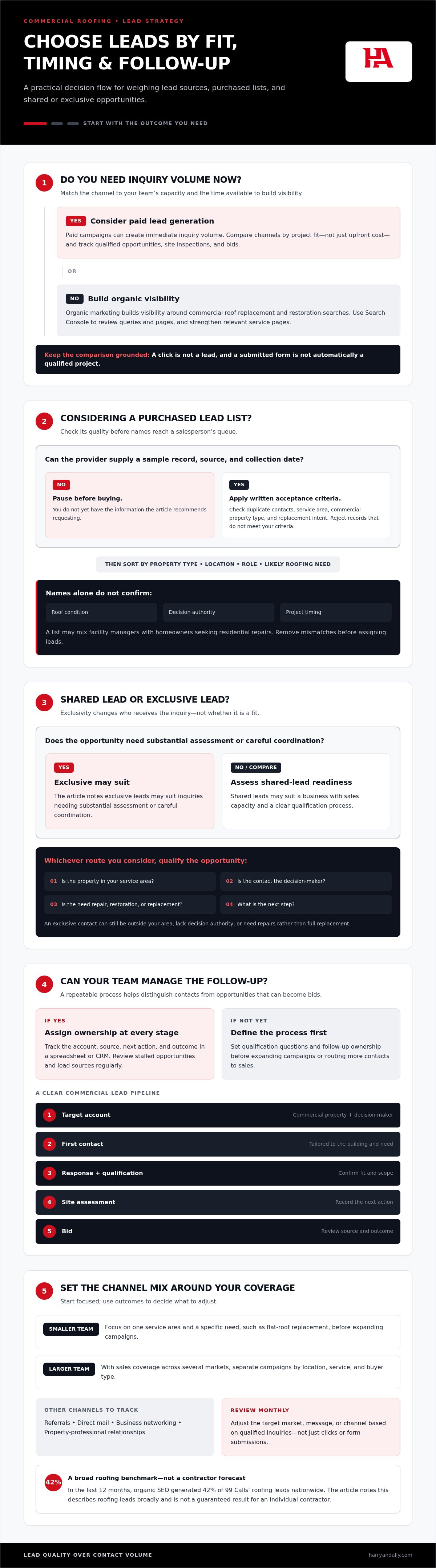
Match your channel mix to your team’s capacity. A smaller roofing company can focus on one service area and a specific need, such as flat-roof replacement, before expanding its campaigns. A larger team with sales coverage across several markets can separate campaigns by location, service, and buyer type. In either case, track qualified opportunities, site inspections, and bids, not just clicks or form submissions. These measures show whether commercial roof replacement leads are progressing toward work.
Paid campaigns are only one option. Traditional commercial roofing channels include referrals, direct mail, business networking, and relationships with property professionals. Track each source in a spreadsheet or CRM, noting the contact, building need, next step, and bid outcome. This makes it easier to compare channels by project fit instead of relying on memory.
Free tools can help roofing contractors improve lead acquisition before increasing spend. Use Google Search Console to find the queries and pages bringing organic visits, then strengthen pages that address commercial roof restoration or replacement. Review your Google Business Profile for accurate service details and current contact information. Useful service pages, clear project examples, and an easy inquiry path help facility managers find and assess your company. Review results monthly, then adjust your target market, message, or channel based on qualified inquiries.
Purchased lead lists versus smart prospecting
How can contractors avoid scams and low-quality commercial roofing leads? Ask for a sample record, the lead’s source, and its collection date before buying. Set written criteria for duplicate contacts, service area, commercial property type, and replacement intent. Reject records that do not meet them.
A purchased list offers names quickly, but names alone don’t reveal roof condition, decision authority, or project timing. A list may mix facility managers with homeowners seeking residential repairs. Before outreach, sort records by property type, location, role, and likely roofing need. Remove mismatches before they reach a salesperson’s queue.
Build a target account list around commercial properties and decision-makers. Start with a defined territory, then identify property owners, facility managers, and portfolio contacts using public company information and business directories. Record each account’s source and next action. A focused outreach sequence could include a tailored introduction, a relevant roof replacement page, and a scheduled follow-up.
Paid lead generation can create immediate inquiry volume, while organic marketing builds visibility around searches for commercial roof replacement or restoration. In the last 12 months, organic SEO generated 42% of 99 Calls’ roofing leads nationwide. That figure describes roofing leads broadly, not a guaranteed result for an individual contractor. Pair channels according to sales capacity and the time available to build search visibility.
Property information makes prospecting more relevant. Organize accounts by building use, location, portfolio size, and known roofing project signals. Then tailor your message: a facility manager may need a clear inspection process, while a property owner may be planning work across several buildings. Keep each message focused on commercial roofing, not generic homeowner repair services.
Create a repeatable lead-generation pipeline with clear stages: target account, first contact, response, qualification, site assessment, and bid. Assign an owner to each stage and track outcomes in a spreadsheet or CRM. Review stalled opportunities and lead sources regularly, then refine the campaign’s audience, message, or follow-up. This keeps growth manageable without treating every new contact as a qualified bid.
Customization matters more than list size. Define the geography, buyer role, roofing service, and qualification questions before launching campaigns. Separate inquiries about restoration, coatings, and full replacement so sales conversations match the building’s need. A focused commercial roofing marketing approach can connect prospecting with the pages and messages that support each campaign.
Exclusive versus shared leads
An exclusive lead goes to one roofing business, while a shared lead may go to several contractors. This affects how you approach the prospect, prioritize follow-up, and evaluate the opportunity. Exclusivity alone does not establish project fit. A contact may still be outside your service area, lack decision-making authority, or need repairs rather than a full replacement.
Shared leads may suit a roofing business with sales capacity and a clear qualification process. If a property manager asks about a leaking warehouse roof, for example, confirm the location, building type, decision-maker, and desired scope. Ask focused questions, then record the next action in your CRM. The aim is to identify a genuine commercial opportunity, not simply to beat other contractors to the prospect.
Exclusive leads may suit inquiries that need substantial assessment or careful coordination. An owner considering replacement across several buildings may need a site review, documentation, and a discussion of project timing. Assigning one salesperson to manage the conversation can maintain continuity. Still, track the source and outcome: exclusivity does not guarantee a qualified prospect or a bid.
Compare both options using the same measures. Record whether the contact fits your service area, represents a commercial property, has a relevant roofing need, and advances to a site assessment or proposal. Note response time and whether the prospect engages. This gives you a practical comparison based on pipeline progress, not the label attached to a lead.
- Choose shared leads when your team can qualify inquiries promptly and handle competition professionally.
- Choose exclusive leads when a focused conversation or coordinated account follow-up matters more.
- Track both by source, qualification, assessment, bid, and outcome in your CRM.
Before committing to either model, confirm how leads are generated, what qualifies as a lead, whether duplicate records are addressed, and how commercial prospects are identified. Ask for examples of the information provided, such as property type, location, and stated roofing need. These details help you assess whether the offering fits your commercial roofing strategy.
Inbound inquiries and direct prospecting can work alongside either arrangement. Someone researching roof replacement may arrive with a defined need, while an introduced contact may need more information. Apply the same qualification process to both. Track which sources and lead types consistently move suitable prospects toward assessment and bidding.
Generating leads among facility managers and property owners
In 2025, 63% of roofing business owners identified generating new leads as their number-one growth challenge. Reaching commercial decision-makers takes more than broad advertising. Roofers need a clear target, relevant proof, and a follow-up process that fits how facility managers and property owners evaluate projects.
Start by identifying buyer roles. A facility manager may coordinate inspections and building operations, while an owner may approve budgets across a property portfolio. Tailor your opening message to that responsibility. For example, address disruption at an operating warehouse or explain how a roof assessment can inform planning across multiple properties.
Give each audience useful evidence. A commercial roofing page can explain restoration and replacement options, outline the assessment process, and show examples of completed commercial projects. Include specific details where available, such as building type and scope. Clear information helps prospects decide whether your team handles the work they need.
Build organic visibility around the terms buyers use when researching roofing concerns. Create focused pages for commercial replacement, restoration, and coatings instead of relying on one generic roofing page. Share those pages through direct outreach and professional relationships. A property manager contacted about a roof issue can review relevant information before scheduling a conversation.
Keep every opportunity moving through a defined process. Roofing companies using a CRM plus marketing automations reported generating 2x as many leads year over year as companies that did not use them, in 2025. Use a CRM to assign an owner, log the inquiry source, set a follow-up task, and record whether the contact advances to assessment or bid.
- Identify the property type and service area.
- Record whether the contact is a manager, owner, or portfolio representative.
- Note the stated roofing concern and requested next step.
- Assign follow-up and track the opportunity’s progress.
For portfolio owners, organize outreach by company and property instead of treating every building as unrelated. One contact may oversee several sites with different roof conditions or project timelines. Keep notes for each location and shape the next conversation around its specific needs. This makes commercial roofing leads easier to qualify and helps your team focus on relevant bids.
Use a coordinated commercial roofing marketing approach to align organic content, targeted outreach, and lead tracking. Review which messages produce qualified conversations, then refine the audience and content around those opportunities.
What rules apply to buying and contacting commercial roofing leads in the United States?
In the United States, the key contact rule in this section concerns calls and texts. As of April 2025, TCPA revocation rules require businesses to honor a person’s opt-out request when they communicate a desire to stop or cancel calls and texts. If a facility manager replies, “Stop texting me,” record that request and suppress further texts to that contact.
Set up opt-out handling before outreach begins. Keep a shared contact record with the phone number, communication channel, request, and date received. If the same property appears in a purchased list and an inbound inquiry, review the contact record before sending another text. This helps prevent a sales handoff from restarting unwanted contact.
Buying a list does not remove your responsibility to manage how your team contacts each person. Before importing records, document their source and label them accordingly. Distinguish between a facility manager who requested roof information and a name found in a directory. Source labels give sales staff context before they call or text about commercial roofing.
Use a practical review process for every lead source:
- Record the source, date received, and commercial property details.
- Check for duplicates and existing opt-out requests before outreach.
- Log each call or text and any response in one shared system.
- Apply an opt-out to the relevant contact record and prevent further calls or texts.
If an owner requests a roof replacement assessment through your website, for example, log the inquiry and the channel they used. If they later ask your team to stop texting, update the contact record immediately and make that status visible to everyone handling the account. A CRM or well-maintained lead tracker can support this process, especially when several staff members manage the same property portfolio.
Set clear internal instructions before campaigns launch. Define who reviews new records, who handles opt-out requests, and how updates reach the sales team. Test the process with a sample contact, then check whether staff can see the contact source and communication status. Review records regularly for duplicates or conflicting entries. A consistent workflow makes outreach more orderly while helping contractors focus on qualified commercial roofing opportunities. Align those procedures with a commercial roofing marketing strategy so campaign outreach and lead handling work together.
H&A Marketing: Website Design
H&A Marketing helps commercial roofing contractors build websites that support lead generation and stronger bid opportunities. Facility managers should be able to understand your replacement and restoration services, review relevant project examples, and find a clear way to inquire. A focused redesign can make your expertise easier to assess if your current site does not communicate it clearly.
Website design works best alongside search engine optimization and consistent branding. Clear service pages support organic discovery, while a cohesive identity helps your company present a professional impression across its website and marketing materials. Lead generation can connect that visibility to a clear inquiry path, making the next step straightforward for prospects.
Consider this approach if your website attracts the wrong inquiries or does not clearly explain your commercial roofing capabilities. Contact H&A Marketing to discuss website design and lead generation for your business.
Turn the Next Opportunity Into a Stronger Bid
Make your next step practical: decide which commercial projects fit your crews, territory, and sales capacity, then use those criteria to assess each inquiry. Commercial roof replacement leads are more useful when every contact enters a clear qualification process with a timely next action.
H&A Marketing can align website design, logo design and branding, and search engine optimization with the commercial roofing work you want to pursue. A clear online presence helps facility managers and property owners understand your services and take the next step.
As your pipeline develops, keep refining the connection between your message, the prospects you attract, and the bids your team wants to win. A consistent strategy makes each marketing decision easier to evaluate.
To discuss your lead-generation priorities, contact H&A Marketing.
Build a stronger pipeline, one qualified opportunity at a time.
Frequently Asked Questions
Why buy roofing leads online?
Online lead channels help contractors reach buyers beyond their existing referral networks. They also let you connect campaigns to the inquiries they produce, so you can see which messages attract commercial prospects. For example, a roof replacement campaign can send visitors to a page focused on that service instead of a general homepage. This makes the next step clearer for prospects and your team.
What are commercial roof replacement leads and how do they work?
These are inquiries or records connected to a possible commercial roof replacement. A lead becomes actionable when your team can identify the property, understand the requested work, and determine who should handle the conversation. Track its progress in your sales system, including whether the opportunity is active, deferred, or closed. That status helps keep a promising contact from being overlooked when a property decision takes time.
What are the best sources for commercial roofing replacement leads in the United States?
Useful sources include Google Ads, organic search, referrals, and professional relationships. The right mix depends on how commercial buyers find contractors and what your sales team can follow up on. Assess each source by its ability to produce relevant inquiries, then connect it to a dedicated landing page or intake path. Reaching the right buyer is more valuable than generating contacts your team cannot serve.
How much do commercial roof replacement leads cost per lead or per month?
There is no dependable rate for every commercial replacement inquiry or monthly campaign. Costs depend on the channel, target market, competition, campaign scope, and how narrowly you qualify leads. Separate the cost of attracting inquiries from the number of prospects that fit your service and project criteria. This helps you judge whether a campaign produces viable opportunities, not just form submissions.
How can roofing contractors generate commercial roof replacement leads online?
Give each online campaign a clear destination and next step. A commercial replacement page, for example, can explain the service and let visitors request a conversation about a property. Keep the message consistent from the ad or search result through the page and follow-up. Review which inquiries lead to sales discussions, then refine the page or campaign based on where prospects lose interest.
How do exclusive commercial roofing leads compare with shared leads?
Compare the agreement details and the sales process each option supports. Check how the source handles duplicate records, what information comes with each inquiry, and how lead ownership is documented. Then assess results using the same internal measures, such as qualified opportunities and proposals generated. This gives your team a practical basis for choosing an arrangement that fits its workflow, without relying on the lead label alone.
How can contractors qualify commercial roofing leads and estimate project value?
Confirm that the lead is within your service area, concerns a commercial property, and comes from someone with decision-making authority. Verify the roofing need and desired scope, then use a site assessment to evaluate the opportunity and track whether it advances to a bid. The available information does not support calculating project value.
What conversion rates and return on investment can contractors expect from commercial roofing leads?
The Home and Home Improvement category has an average conversion rate of 8.05%, but that broader figure is not a commercial roofing forecast. Estimate performance by tracking qualified opportunities, site assessments, bids, and outcomes against lead costs; no specific return on investment is provided.
