
Commercial Roofing Contractor Branding That Wins Property Owners

Article by
Harry Stanley III
Harry Stanley III is a construction marketing strategist and fractional CMO at H&A Marketing. He has helped construction companies grow through website strategy, SEO, paid advertising, branding, lead generation, CRM systems, and professional content. His past work includes helping Meraki Solar generate an additional $3.7 million in revenue in his first year and supporting American Builders as a fractional CMO. Today, Harry works directly with custom home builders and construction companies to build marketing systems designed to generate qualified leads and measurable growth.
Strong commercial roofing contractor branding makes your specialty clear, looks professional wherever prospects encounter it, and stays consistent across your website, trucks, uniforms, and proposals. Keep your logo recognizable at a glance, choose colors that support the impression you want to make, and use language that reflects the projects you want to win. Your brand should speak to property owners and facility teams, not simply borrow cues from residential or storm-restoration companies.
A memorable logo matters, but it can’t carry the whole brand. Property owners also notice whether your messaging, project imagery, and follow-up are consistent and relevant to their needs. This guide shares practical roofing branding tips, explains how logos work across customer touchpoints, and shows how residential, commercial, and storm-restoration contractors can develop distinct identities. You’ll also learn what brand colors can communicate and how to use them consistently, so your marketing presents a clear picture of the work your company is built to do.
Key Takeaways
- Build a consistent identity that holds together across jobsite vehicles, uniforms, proposals, and digital channels.
- Design a logo to stay clear and recognizable wherever property owners encounter it, from a truck to a website.
- Shape your message around the work you want to win, whether that’s commercial restoration and replacement, residential roofing, or storm response.
- Choose a focused color palette that supports the impression you want your company to make.
- Plan branding costs around the scope of work, such as the identity, materials, and digital updates your business needs.
1. What Are Some Roofing Company Branding Tips?
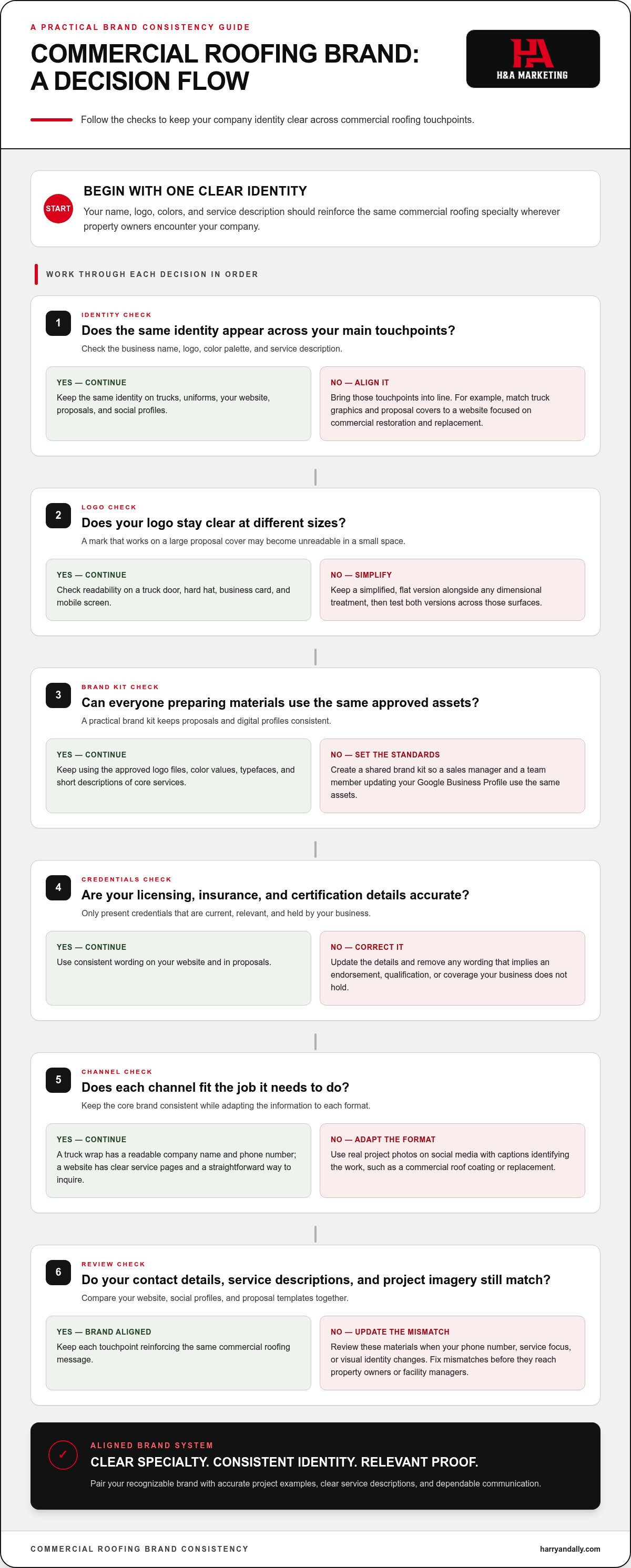
Start with one clear identity, then apply it consistently wherever property owners encounter your company. Use the same business name, logo, color palette, and service description on your trucks, uniforms, website, proposals, and social profiles. If your website highlights commercial roof restoration and replacement, for example, make sure your truck graphics and proposal cover reinforce that same specialty.
Check how your logo works at different sizes before ordering signs or apparel. A detailed mark that looks sharp on a large proposal cover may become unreadable on a uniform chest or small website icon. Keep a simplified, flat version alongside any dimensional treatment. Test both versions on a truck door, hard hat, business card, and mobile screen before approving production.
Build a practical brand kit for everyone preparing your marketing materials. Include approved logo files, color values, typefaces, and short descriptions of your core services. A sales manager creating a proposal and a team member updating a Google Business Profile should use the same approved assets. Consistent branding supports recognition and preserves a brand’s core meaning, according to the U.S. Environmental Protection Agency.
Licensing, insurance, and certifications affect your branding because they determine which credentials you can accurately claim. Show current, relevant details on your website or in proposals, and use consistent wording across channels. Don’t imply an endorsement, qualification, or coverage your business doesn’t hold.
Avoid common mistakes such as using different logos on trucks and proposals, listing services you don’t perform, or publishing outdated contact details. Inconsistent or inaccessible communications can weaken credibility, according to the United States Environmental Protection Agency. Review your website, social profiles, and proposal templates together whenever your phone number, service focus, or visual identity changes.
Make each channel reinforce the same message, while adapting the format to its job. A truck wrap needs a readable company name and phone number; a website needs clear service pages and a straightforward way to inquire. On social media, use real project photos with captions that identify the work, such as a commercial roof coating or replacement. These construction branding principles help keep each touchpoint aligned.
Build brand recognition through useful, repeated contact, not just logo placement. Share a completed project on your website, feature the same work in a proposal, and use a jobsite sign where appropriate. During a regular brand review, compare the logo, service descriptions, contact details, and project imagery across your channels. Fix mismatches before they reach facility managers or property owners.
2. Why roofing company logos matter across customer touchpoints
A commercial roof can be a major property decision, so owners look for clear signals before starting a conversation. A recognizable logo connects your proposal, website, work truck, and project photos to the same company. That visual continuity makes it easier for a property manager to remember who submitted a roof restoration plan or discussed a replacement.
Trust comes from more than a polished mark. Commercial roofers build trust by pairing a professional logo with accurate project examples, clear service descriptions, and dependable communication. A facility manager reviewing a proposal, for instance, should see the same company identity on its cover, website, and follow-up email, alongside details that match the proposed work.
Each touchpoint has a different job. A truck logo needs to be legible from a distance, while a website header must remain clear on a phone. On a proposal, it should support recognition without competing with the scope, schedule, or project photographs. Test the logo in each setting before finalizing the design.
Customer feedback can reveal what your visual identity should reinforce. Review past conversations, testimonials, and notes from completed commercial projects. Look for specific strengths customers mention, such as organized communication, careful site coordination, or clear explanations of roof coating options. Use recurring themes to shape supporting messages and imagery rather than making broad claims customers haven’t expressed.
Expectations also differ by audience. A property owner comparing replacement proposals may want a clear scope and credible examples. A facility manager coordinating active operations may value communication about access, scheduling, and disruption. Your logo won’t answer those questions by itself, but a consistent identity helps customers recognize the materials that do. Pair it with relevant project descriptions and direct, useful language.
Keep the logo functional as well as distinctive. Avoid tiny roof details, thin lettering, or complex effects that disappear on a business card or email signature. A simplified version may work better in small spaces, while a fuller treatment may suit a proposal cover. Check contrast against light and dark backgrounds, then review printed and digital versions for readability.
Use the logo as a recognition cue, not a substitute for evidence. A project page featuring a commercial roof restoration should accurately identify the work and explain the property challenge. A proposal should connect the same identity to a specific scope. These details help prospective customers understand what your company does and assess whether its experience fits their building.
Finally, ask customers what they recall after reviewing your materials. If they remember a roof icon but can’t identify your commercial specialty, clarify the surrounding message. If they cite a particular project or service strength, make that proof easier to find. Feedback from actual property owners gives you a practical basis for refining how your company is presented.
3. Branding differences for residential, commercial, and storm restoration contractors
A residential roofing brand often speaks to homeowners choosing work for one property. A commercial roofing brand needs to address property owners, facility managers, and sometimes procurement teams. That difference should shape your language, project examples, and calls to action. Commercial roofing contractor branding works best when it reflects the buyer’s priorities. A contractor focused on replacements might lead with project planning and occupied-building coordination, rather than imagery aimed at homeowners.
Residential branding commonly puts the home and homeowner at the center. A neighborhood project photo, a clear replacement description, and approachable language can help explain the service to an individual buyer. Commercial branding should instead feature relevant facilities and explain the contractor’s fit for larger properties. A portfolio might group roof restorations, coatings, and replacements by project type, helping facility managers find work resembling their building.
Storm-restoration branding has a different emphasis. It can focus on damage assessment, restoration work, and clear next steps after severe weather. Avoid using storm-response language in every commercial message if your business also pursues planned replacements. A property owner planning a capital project needs information about scope and project fit, not only urgent repair messaging.
Choose the customer and project type you want to reach before designing campaign materials. A commercial contractor can focus on select bid lists or specific industries rather than presenting itself as right for every roof. A company pursuing warehouse projects, for example, can feature relevant facilities and describe restoration and replacement work in terms those property teams recognize.
Then align your identity with the sales process. A residential inquiry might begin with a homeowner requesting an estimate for one building. A commercial opportunity may involve a facility manager, an owner, and a proposal review. Use audience-specific website pages, project profiles, and proposal language to help each stakeholder understand your focus. A focused commercial roofing contractor branding strategy keeps the promise consistent while making the evidence relevant to each buyer.
If your company serves more than one market, distinguish the messages without creating competing identities. Keep the same company name and core visual identity, then organize website navigation and project examples by audience. A commercial property owner should quickly find commercial restoration work, while a homeowner should find residential information in its own section. This structure keeps storm, residential, and commercial claims from blurring together.
Review the fit by comparing your current materials with the work you want next. Check whether your homepage, proposal introduction, and project portfolio speak to the same buyer. If you want more facility-manager conversations about roof replacements, feature relevant commercial examples and a direct inquiry path. Strong positioning helps prospects understand which projects your company pursues and why your experience fits.
4. Color choices and brand associations
Choose colors that support the impression you want property owners to take away. A commercial roofer might use navy to suggest a measured, established presence, paired with a brighter accent for visibility. These are design associations, not proof of workmanship. Your project record, proposals, and customer communication must support the impression your palette creates.
Keep the palette simple. Roofing companies can build an identity around a small set of colors, making them easier to apply across signs, uniforms, proposals, and digital profiles. For example, use a dark primary color for headings, a lighter background for readable text, and one accent for buttons or key details. Give each color a clear role.
Check contrast before approving the palette. A white company name on a pale background may disappear on a truck door or mobile screen. Test the same logo on light and dark surfaces, then review small text on a phone. If a facility manager can’t quickly read your name or service message, adjust the contrast or simplify the layout.
Consider the materials where the colors will appear. A truck wrap, embroidered uniform, printed proposal, and website won’t reproduce color in exactly the same way. Request proofs in the formats you plan to use. Compare them under ordinary viewing conditions, such as a printed proposal on a desk and a logo displayed on a phone outdoors.
Make the palette fit your market position. A contractor pursuing commercial roof replacements might choose restrained colors and straightforward typography to convey a professional, established impression. A company emphasizing storm restoration may use a brighter accent to make contact details prominent. In either case, don’t let color imply services or response capabilities your business doesn’t provide.
Review nearby competitors’ visual identities before choosing your final combination. The goal isn’t to copy another roofer’s palette. Look for a way to remain recognizable in a crowded bid packet, search result, or local business listing. A distinct accent, clear wordmark, and consistent use of color can help separate your materials without relying on elaborate graphics.
Set simple usage rules so every channel presents the same identity. Record approved color values, background options, and contrast choices in a brand guide. Share it with anyone preparing proposals, updating social media, or ordering uniforms. For example, specify which color to use for headings and which accent to use for a website inquiry button.
Test the palette against real commercial roofing content. Place it beside a roof restoration project photo, a replacement proposal, and a social media post. Check whether the color helps readers find the company name and service details or competes with project information. Refine the system before applying it across your marketing materials.
5. How much does branding cost for a commercial roofing company?
There isn’t one fixed price for every commercial roofing brand. The cost depends on the project, including its scope, deliverables, and how many existing materials need updating. A logo refresh for proposal templates differs from building an identity for trucks, uniforms, signage, and digital channels.
Start by defining the work you need. A company with a usable logo may only need a consistent color system and updated proposal materials. A contractor changing its name or market focus may need a broader identity, including a new logo, brand guidelines, and updated sales documents. List the deliverables before requesting a quote.
Count the places where your identity needs to work. A logo for a website header has different practical demands from one used on a truck wrap or embroidered uniform. Include proposals, business cards, jobsite signs, email signatures, and social profiles in the scope. More applications may require additional production-ready versions and review work.
Existing assets also affect the project. If your company already has clear project photography, approved service descriptions, and usable logo files, those materials can inform the identity work. If current assets conflict, such as different business names on proposals and social accounts, resolving those inconsistencies may add steps before preparing new materials.
Request a quote that separates the core identity from optional applications. For example, ask for separate scope details for logo design, a basic brand guide, proposal templates, and vehicle graphics. This makes trade-offs easier. You might prioritize a usable logo system and sales documents first, then plan truck graphics alongside your next fleet update.
Clarify practical deliverables before work begins. Ask which final file formats are included, how many design directions and review rounds the scope covers, and whether the quote includes artwork for specific uses. These details help you compare proposals accurately. An initial quote may cover only a logo concept, while your team needs files ready for print and digital use.
Set your budget according to business priorities, not appearance alone. If your next growth goal is commercial roof replacements, prioritize materials that support property-owner outreach and bid presentations. If your brand is recognizable but outdated online, focus on the applications prospects see most. Keep the first phase focused on gaps that affect credibility and sales conversations.
Before requesting a quote, prepare your current logo, examples of materials, target project types, and a list of required deliverables. These details create a practical starting point for a construction branding scope discussion and help align the work with your commercial roofing sales pipeline.
H&A Marketing: Website Design
H&A Marketing helps commercial roofing contractors turn a clear brand into a website that supports their commercial roofing marketing. If your logo and project materials look consistent but your website doesn’t explain your restoration or replacement work clearly, a redesign can connect those pieces.
Website design can organize service details, project examples, and inquiry paths so facility managers can find relevant information. H&A Marketing’s Logo Design & Branding supports a consistent identity, while Search Engine Optimization and Lead Generation help connect that presentation with prospects seeking commercial roofing services.
This is a practical next step when your brand needs to carry from a proposal through to a useful online presence. Discuss your commercial roofing marketing needs with H&A Marketing.
Make your next brand decision count
Your next step is to connect your brand to the commercial work you want to pursue. Use the projects you want more of to guide what prospects see first, what your materials emphasize, and how your team presents the business. Commercial roofing contractor branding is most useful when it supports a clear direction, not just a fresh look.
If your identity and online presence feel disconnected, H&A Marketing can align Logo Design & Branding with Website Design and Search Engine Optimization. This gives property owners a clearer path from recognizing your company to understanding its commercial roofing work. Start with the gap that matters most to your sales process, then build from there.
A focused brand gives your team a stronger foundation for every property-owner conversation. Choose the next step that fits your goals and keep moving forward.
Frequently Asked Questions
What Are Some Roofing Company Branding Tips?
Begin with a precise positioning statement your sales team can use. Name the commercial roofing work you want to be known for, the customer you serve, and the practical value you bring. Make the statement useful in sales conversations: train estimators to explain it and include it in call notes or proposal introductions. Review incoming inquiries periodically to see whether the message attracts the project types your company wants.
What Branding Elements Should Roofers Know?
Define the verbal parts of your identity, not just the visual design. Set a preferred company description, a short explanation of your approach, and guidelines for claims your team can support. Create an approved proof library of customer-approved testimonials, project facts, and credentials for proposals or online use. A clear approval process helps prevent unsupported promises from appearing in sales materials.
What Makes a Great Roofing Logo?
A strong roofing logo has a distinctive idea customers can associate with your company, rather than relying on a familiar roof outline alone. Consider a memorable letterform, geometric mark, or restrained roof reference that fits your positioning. Ask whether the design will still feel appropriate years from now. The logo identifies the business; your service copy explains exactly what the company does.
How should commercial roofing contractors choose a company name, logo, and tagline?
Give the three elements different jobs. The name identifies the company, the logo creates a recognizable visual mark, and the tagline clarifies a relevant benefit or specialty. Test the name aloud with sales staff and customers for easy pronunciation and recall. Keep the tagline specific and supportable, such as describing a commercial roofing focus, rather than promising outcomes your team can’t control.
What branding strategies help commercial roofers stand out from competitors?
Own a clear point of difference and show how it works in practice. Your distinction might be a defined specialty, a particular way of organizing proposals, or a communication standard during active projects. Turn that distinction into useful sales content, then track which inquiries become qualified opportunities. Comparing lead sources and project fit helps you invest in messages that support the pipeline, not just attract attention.
