
Commercial Roofing Sales Process: From First Call to Signed Contract

Article by
Harry Stanley III
Harry Stanley III is a construction marketing strategist and fractional CMO at H&A Marketing. He has helped construction companies grow through website strategy, SEO, paid advertising, branding, lead generation, CRM systems, and professional content. His past work includes helping Meraki Solar generate an additional $3.7 million in revenue in his first year and supporting American Builders as a fractional CMO. Today, Harry works directly with custom home builders and construction companies to build marketing systems designed to generate qualified leads and measurable growth.
A commercial roofing contract can be won or lost before the proposal reaches the buyer. A strong commercial roofing sales process takes each opportunity from lead intake and qualification through roof assessment, estimating, proposal delivery, follow-up, and handoff to production. Assign an owner to every stage so opportunities don’t stall between the first call and a signed agreement.
Commercial roof restorations and replacements often involve several decision-makers, detailed scopes, and long sales cycles. A sound process accounts for these realities: sales learns what the property needs, estimating prepares a clear scope, and operations gets the context needed to deliver the work.
This guide covers the steps from first inquiry to project kickoff, with practical advice on assigning responsibilities, qualifying opportunities, presenting value, and following up. You’ll also learn how a coordinated sales and marketing pipeline can help your team focus on qualified commercial projects instead of letting promising leads go quiet.
Key Takeaways
- Qualify each opportunity by the roof’s needs, the buyer’s budget, and who has authority to approve the work before investing in a detailed proposal.
- Use LAER to handle objections: listen, acknowledge the concern, explore what’s behind it, then respond with relevant information.
- Track each lead, proposal, next step, and follow-up in one clear system so commercial opportunities don’t get lost between conversations.
- Choose a sales team structure that assigns clear ownership from first contact through estimating, proposal delivery, and handoff to production.
- Make it easier for facility managers and property owners to find and understand your restoration and replacement services with a focused website and lead-generation approach.
What is the roofing sales process step by step?
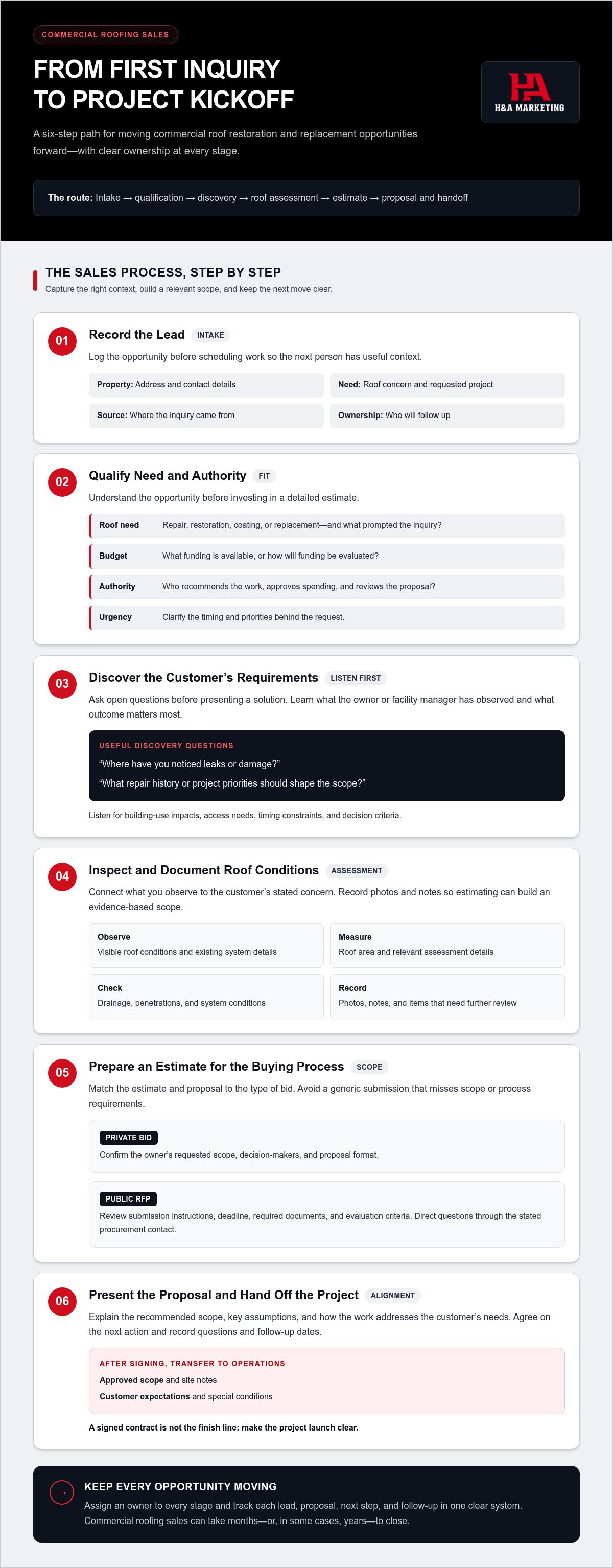
Move every commercial opportunity through intake, qualification, discovery, inspection, estimating, proposal, and handoff. Assign an owner to each step, since commercial roofing sales can take months or, in some cases, years to close.
- Record each lead before scheduling work. Capture the property address, contact details, roof concern, and requested project, such as a restoration or replacement. Note the inquiry source and who will follow up. Complete intake gives the next person useful context and helps prevent a facility manager’s request from getting lost in calls or email.
-
Qualify Leads by Need and Authority
Ask whether the property needs a repair, restoration, coating, or replacement, and what prompted the inquiry. Clarify the available budget or how funding will be evaluated. Identify who recommends the work, who approves spending, and whether other stakeholders need to review the proposal. A lead is better qualified when you understand need, budget, authority, and urgency before estimating begins.
-
Discover Customer Requirements
Ask open-ended questions before presenting a solution. Find out what the owner or facility manager has observed, how roof issues have affected building use, and what outcome matters most. During an inspection, ask: “Where have you noticed leaks or damage?” and “What repair history or project priorities should shape the scope?” Listen for access needs, timing constraints, and decision criteria.
-
Inspect and Assess Roof Conditions
Inspect the roof, document visible conditions, and connect each observation to the customer’s stated concern. A commercial roof assessment combines direct observation with measurements of the roof area and relevant details, such as drainage, penetrations, and existing system conditions. Record photos and notes so estimating can develop an evidence-based scope. Explain what the assessment supports and what needs further review.
- Prepare an estimate that fits the buying process. For a private bid, confirm the owner’s requested scope, decision-makers, and proposal format. For a public RFP, review its submission instructions, deadline, required documents, and evaluation criteria before committing resources. Direct questions through the stated procurement contact. Avoid generic proposals that overlook specified scope items or submission requirements.
- Present the proposal, agree on the next action, and document the handoff. Explain the recommended scope, key assumptions, and how the work addresses the customer’s needs. Record questions and follow-up dates in the opportunity file. After signing, transfer the approved scope, site notes, customer expectations, and special conditions to operations. A successful process ends with a clear project launch, not just a signed contract.
Using the LAER approach to address objections
Use LAER to handle objections without rushing into a pitch: listen, acknowledge, explore, then respond. In commercial roofing, this sequence can reveal whether a concern involves scope, budget, timing, or decision-making.
- Listen without interrupting. Let the property owner or facility manager explain the concern, then summarize it plainly. If they say, “We’re not ready to replace the roof,” don’t immediately argue for replacement. Clarify whether they’re questioning the condition, timing, project disruption, or proposed investment. The first concern they voice may not be the main obstacle.
- Acknowledge the concern before offering a solution. You might say, “You need to understand the project’s impact before approving work.” This shows you heard the buyer without endorsing an assumption about the roof. Respond specifically to their words. Avoid canned reassurances or jumping to product details before you know what needs resolving.
- Explore what’s behind the objection. Ask, “What would you need to see to compare these scopes?” or “Who else needs to review the recommendation?” A budget objection may reflect a funding limit, uncertainty about value, or a competing priority. An authority objection may mean the contact needs materials for an owner, board, or procurement team. Let their answer guide the next step.
-
Address Price and Competitor Concerns
Compare the proposal with a competing offer by scope, not just total price. Review the included work, assumptions, exclusions, and documented roof conditions behind your recommendation. If the buyer says the project costs too much, explore the budget concern before discussing options. Financing may help with budget concerns when available, but don’t imply it resolves every objection.
-
Handle Common Roofing Objections
If a buyer says, “I need to think about it,” ask what remains unclear and what information would help. If they’re concerned about disruption, ask about tenant access, business operations, and scheduling priorities. Don’t dismiss these concerns. Record the answer and shape the next conversation around the buyer’s actual needs.
- Respond with relevant evidence and agree on a next action. If the concern is roof condition, present inspection findings tied to the proposed scope. If it’s timing, discuss the customer’s priorities and the project sequence. If they need internal approval, prepare a concise summary to share. Confirm who will take each action and when you’ll follow up, then record the outcome.
Clear, consistent messaging helps set expectations before sales conversations begin. A focused commercial roofing marketing strategy can align your website and lead generation with the work your team is prepared to sell.
CRM, quoting, and follow-up technology
Record an owner, next action, and proposal status for every opportunity. Use that information to keep estimating, customer conversations, and production handoffs connected.
-
Use CRM and Quoting Tools
Enter each inquiry in a CRM or project board, then assign its next action. Record the property, contact, roof concern, lead source, and current stage. Call digital leads within 5 minutes; waits beyond 30 minutes are associated with a contact-rate drop of over 60%. Track attempts and outcomes so the team can see which opportunities need attention.
Keep notes specific: “facility manager requested a replacement scope” is more useful than “follow up.” Set reminders for proposal delivery and customer responses. A shared record helps the estimator and salesperson work from the same version of the opportunity.
-
Prepare the Roofing Proposal
Build the proposal from inspection notes, measurements, and the customer’s stated priorities. Compare repair and replacement by documenting the observed condition, proposed work, and how each option addresses the issue. Explain the basis for your recommendation without presenting assumptions as inspection findings.
Include the scope, materials, relevant warranty terms, exclusions, and project assumptions. Specify the work included and identify anything outside the proposed scope. Check that quantities and customer details match the estimate. A clear document helps owners compare proposals by scope, not just price.
- Send the quote the same day it’s prepared, then record the delivery date and next follow-up in the CRM. If the buyer hasn’t decided during the proposal meeting, follow up that evening, then at 24 hours and 72 hours. Use each contact to answer a specific question or confirm the decision process, not merely ask whether they’ve signed.
- Train salespeople in system knowledge, installation methods, proposal delivery, objection handling, and job profitability basics. Use recent project examples to practice explaining why repair suits one roof while replacement better addresses another. Review sales calls with participants’ permission, then coach one practical improvement at a time.
- Present the recommendation with supporting evidence and a clear next step. Balance roof-condition facts with customer priorities, such as reducing disruption or planning future work. Ask whether the scope addresses their concern, resolve remaining questions, and confirm who approves the contract. Track close rate alongside lead-to-appointment conversion and win-loss reasons, so coaching targets the stage where opportunities stall.
Roofing sales teams with the right technology tools have a 10-15 percentage-point close-rate advantage over teams using spreadsheets and phone calls.
Text confirmations with a company-page link can reduce roofing appointment no-shows by 30-40%.
Lead generation through door-knocking and inbound leads
Build a prospecting mix around commercial property owners, facility managers, and general contractors. Track which sources produce qualified restoration and replacement opportunities, not just inquiries.
-
Prospect and Canvass Roofing Leads
Choose target properties before canvassing, then tailor your opening to the building and likely decision-maker. Commercial cold-calling may suit this market better than residential-style door-knocking because it can reach property managers responsible for multiple sites. Keep each conversation focused on the prospect’s roofing needs, current project plans, and bid process. Log the contact and agreed next step.
-
Respond to Inbound Leads
Assign an owner to every inbound inquiry and record the property, contact’s role, requested work, and lead source. A facility manager asking about roof coating needs a different discovery path from an owner seeking a full replacement. Respond promptly, clarify the project scope and decision process, then record whether the lead warrants an inspection or another follow-up.
- Develop referral and bid relationships alongside direct outreach. Introduce your commercial roofing services to general contractors, building owners, and property managers. Ask how they identify roofing needs and receive invitations to bid. Record each relationship, property type, and relevant project discussion. A useful prospect list guides follow-up, rather than collecting names without context.
- Make inbound marketing useful to commercial buyers. A property owner researching a recurring leak should quickly find relevant information about restorations, repairs, and replacements. Explain the problems your team addresses, the buildings you serve, and how to request an assessment. Clear service pages help prospects decide whether your company fits before they call. Vague claims, by contrast, can attract inquiries outside your project focus.
- Assess lead sources by more than inquiry volume. Track the source, building type, requested service, qualification status, inspection outcome, proposal, and contract result. Compare channels by the quality and progress of the opportunities they produce. If a source repeatedly brings residential requests or projects outside your target scope, adjust its audience or messaging. If referrals lead to bid invitations, invest time in those relationships.
- Connect outreach to a consistent follow-up routine. After a call, canvassing visit, referral, or web inquiry, record what the prospect said and the next useful action. Share relevant project information instead of generic sales messages. Commercial decisions may involve several stakeholders, so keep the opportunity active with meaningful updates and clear follow-up dates.
For contractors who need a steadier flow of qualified commercial opportunities, lead generation for construction companies can connect outreach with the right prospects and project types.
Sales team structures for roofing contractors
Design sales roles around the needs of each opportunity, not a generic residential model. For commercial restorations and replacements, clear ownership across sales, estimating, and operations prevents gaps between the promise and delivery.
- Map handoffs before assigning titles. List the stages from inquiry through signed contract and project kickoff, then name the person accountable at each stage. A smaller contractor may have one salesperson handle discovery and follow-up while an estimator prepares the scope and pricing. The key is to make responsibility visible, even when one person holds several roles.
- Separate relationship ownership from technical estimating when workload allows. The salesperson can manage the facility manager’s questions, decision timeline, and internal stakeholders. The estimator can focus on roof conditions, quantities, scope, and assumptions. Set a handoff point, such as after the site assessment, so both roles share notes before preparing a proposal.
- Give operations a defined role before the contract is sold. Ask a production lead to review access, sequencing, labor assumptions, and unusual site constraints. A roof restoration proposal that overlooks building operations can create friction after signing. A pre-job kickoff between sales and operations helps align the sold scope with how the crew will do the work.
- Choose a structure that fits your pipeline. A contractor with a steady flow of qualified opportunities may divide prospecting, closing, and estimating. A leaner team may combine those functions but assign clear next actions. Avoid handoffs that slow decisions without improving scope accuracy, customer communication, or project profitability.
- Train the whole team on the commercial roof systems you sell. Sales representatives need enough product and installation knowledge to accurately explain a recommendation for restoration, coating, or replacement. Estimators need to understand customer priorities, while operations needs the approved scope and commitments. Shared training reduces mismatched expectations and supports a consistent customer experience.
- Review performance as a team. Use weekly or bi-weekly sales meetings to examine lead progression, close rate, proposal quality, and stalled opportunities. Discuss specific examples: Was the decision-maker involved? Did estimating receive complete inspection notes? Did operations flag a production concern? Tie incentives to profitable work, handoff quality, customer satisfaction, and repeat business, not contract volume alone.
- Keep the structure adaptable. If proposals stall after estimating, improve the estimating-to-sales handoff. If signed work creates production surprises, strengthen operations review. Use the pattern behind missed opportunities to adjust roles, coaching, and meeting agendas, aligned with a commercial roofing marketing strategy that supports the project types your team is structured to pursue.
H&A Marketing: Website Design
H&A Marketing helps commercial roofing contractors strengthen the path from online inquiry to qualified sales conversation. Turn to the team when your website doesn’t clearly explain roof restoration and replacement work, or makes it hard for property owners to take the next step.
H&A’s website design for construction companies can organize service information around the questions facility managers and property owners need answered. Search Engine Optimization and Lead Generation support visibility and inquiry generation, while Logo Design & Branding can make your business identity consistent across marketing materials. These pieces help prospective customers understand what you do before your sales team follows up.
If your website and lead flow aren’t supporting your sales process, contact H&A Marketing to discuss a practical next step.
Build a Sales Pipeline That’s Ready for the Next Project
A stronger commercial roofing sales process starts by connecting how prospects find your company with how your team handles each opportunity. Review where qualified inquiries come from, whether your online presence reflects the restoration and replacement work you want, and whether prospective customers know how to take the next step.
H&A Marketing can support that foundation through Website Design, Search Engine Optimization, and Logo Design & Branding. Together, these services help present a consistent, clear picture of your commercial roofing business to facility managers and property owners. The right place to start depends on where your current sales pipeline needs support.
Bring your goals and current challenges to a conversation with H&A Marketing, then choose a practical next step for your business.
Frequently Asked Questions
What are the steps in a commercial roofing sales process?
Make each stage a decision gate, with a clear record of what’s complete. For example, don’t move an opportunity to estimating until the site contact, requested work, and assessment notes are attached. Before production accepts a signed job, compare the approved contract with the final estimate and flag any changes. These checkpoints help managers identify incomplete handoffs without reviewing every conversation.
How do commercial roofing sales teams qualify leads and identify decision-makers?
Clarify how the organization buys roofing work, not just who signs. Ask whether the property belongs to a larger portfolio, follows a capital planning cycle, or requires a specific vendor or bid format through procurement. A building contact may coordinate access while an asset manager reviews the business case. Map the roles and approval steps before setting expectations about timing.
What sales techniques help commercial roofing contractors build trust and close deals?
Make the buying experience easy to navigate. Use a consistent point of contact, label project documents clearly, and tell the customer what to expect after each meeting. For a property with several stakeholders, provide a brief decision memo explaining the proposed work, key assumptions, and open questions. This gives the internal team a shared reference instead of relying on secondhand summaries.
What are common risks and objections in commercial roofing sales, and how can sellers address them?
Watch for bid requests that don’t match your capabilities, unclear responsibility for related building work, and late scope changes. Before committing estimating time, compare the opportunity with your target project types and available production capacity. If requirements shift during review, document the change and its effect on the proposal. This keeps expectations clear without treating every inquiry as a fit.
How should commercial roofing sales teams follow up after a proposal and measure conversion rates?
Measure each pipeline stage using a consistent denominator. For example, calculate proposal-to-contract conversion by dividing signed contracts by proposals delivered in the same reporting period. Segment results by lead source and project type, then review losses separately from opportunities still under consideration. This helps show whether a channel attracts poor-fit prospects or qualified buyers simply need more time to decide.
