

Article by
Harry Stanley III
Harry Stanley III is a construction marketing strategist and fractional CMO at H&A Marketing. He has helped construction companies grow through website strategy, SEO, paid advertising, branding, lead generation, CRM systems, and professional content. His past work includes helping Meraki Solar generate an additional $3.7 million in revenue in his first year and supporting American Builders as a fractional CMO. Today, Harry works directly with custom home builders and construction companies to build marketing systems designed to generate qualified leads and measurable growth.
A commercial roofing website should help facility managers assess whether your company can handle their building, roofing needs, and next steps. Strong commercial roofing website design does more than look polished: it clearly explains restoration and replacement services, builds confidence with relevant project examples, and makes it easy to request an RFQ.
A professional impression matters, but a commercial roofing website must also answer practical questions quickly: what work you do, which properties you serve, how an assessment or proposal begins, and what information helps your team respond. This guide covers the pages and details that support those decisions, including service and project content, mobile-friendly layouts, focused calls to action, useful RFQ forms, and call tracking. It also explains how clear design and writing can attract better-fit opportunities, while connected lead tracking keeps inquiries visible through a longer sales process. The goal is a site that gives property owners and facility teams a clear reason to get in touch, with the information they need easy to find.
Key Takeaways
- Explain your commercial roofing services, ideal projects, and process so property owners can quickly assess whether your team is a fit.
- Use clear writing and project evidence to make your expertise easier to understand and trust.
- Design RFQ forms and calls to action around the information your team needs to qualify an opportunity.
- Connect call tracking and lead follow-up so inquiries don’t disappear between the website and your sales pipeline.
- Choose a website platform based on your site’s needs, long-term flexibility, and how easily your team can manage it.
What should a commercial roofing website explain?
A commercial roofing website should explain which projects you handle, who you serve, and how prospects can request an assessment. Facility managers, for example, should be able to distinguish your restoration, replacement, and roof coating services at a glance.
Organize service information around the decisions property owners need to make. Describe the roof systems and project conditions your team handles, the properties you serve, and the general steps from an initial conversation to a proposal. A restoration page might explain how an assessment determines whether restoration is suitable; a replacement page can outline how your team scopes the work. Keep technical details accurate, and ask roofing specialists to review claims before publication.
When comparing commercial roofing website design agencies, look at their construction work, service-page writing, SEO approach, and ability to connect inquiries with your sales process. Choose a process that turns your actual project types into clear pages instead of relying on generic contractor templates.
Support accessibility with practical features such as keyboard-friendly navigation, readable contrast, descriptive links, and clearly labeled form fields. For privacy, explain what information an RFQ form collects and how your business uses it. Applicable obligations may depend on the information collected and where your business operates.
Local SEO content should connect each service to the markets your company actually serves. Professionals can build location pages with relevant service details, consistent business information, and examples tied to local projects, rather than duplicating one page with only city names changed. A clear construction web design approach keeps page structure, service details, and location relevance working together.
Project pages make your capabilities easier to assess. A useful case example can identify the property type, roofing challenge, work completed, and outcome, using approved details and jobsite photos or video. You can also organize certifications and warranty information into readable sections, using only current credentials and terms supplied by your team. Video can show roof conditions, restoration stages, or completed work. Captions and a short written summary help visitors understand the footage.
Additional pages should answer distinct buyer questions, not simply increase the page count. Create separate content for roof coatings, restoration, replacement, industries served, and project examples when each page can offer useful information. Plan content creation as a sequence: gather service details, interview the people who scope and sell projects, draft the pages, review technical accuracy, then publish and update them as your services or proof change.
Common design risks include vague service descriptions, outdated project photos, unsupported warranty claims, and forms that ask for too much information. A facility manager seeking a replacement proposal needs a clear next step, not buried contact details or confusing technical copy.
Custom website design, writing, and development
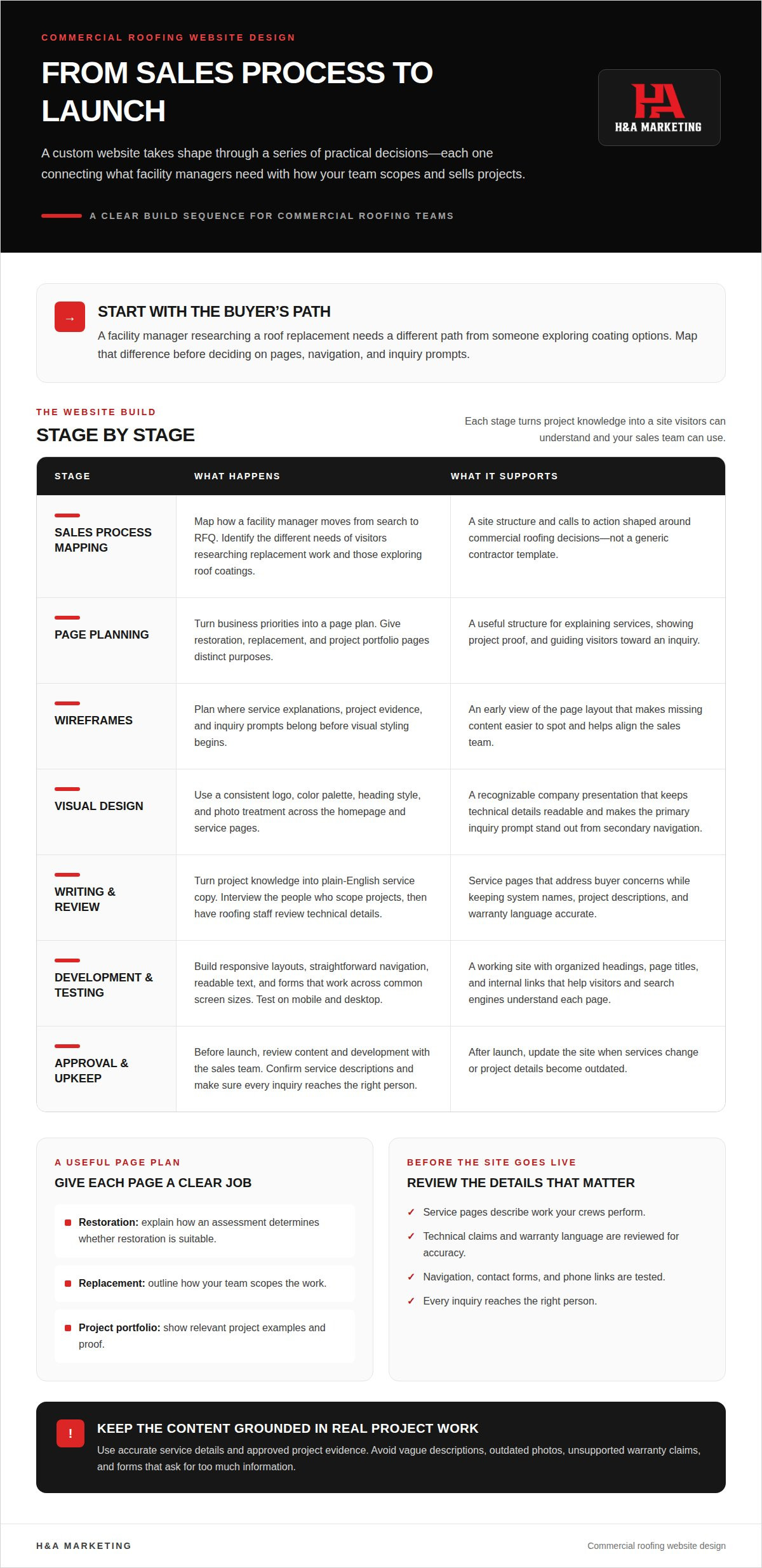
A custom site begins with a working session about your sales process. Map how a facility manager moves from search to RFQ. Someone researching a roof replacement, for example, needs a different path from a visitor exploring coating options. That distinction informs the page structure, navigation, and calls to action, keeping the site focused on commercial roofing rather than generic construction.
Next, turn your business priorities into a page plan. A restoration page, replacement page, and project portfolio each need a distinct purpose. Wireframes show where service explanations, project proof, and inquiry prompts belong before visual styling begins. This makes missing content easier to spot early and helps align your sales team on what each page should accomplish.
Visual design should make your company recognizable without competing with useful information. A consistent logo, color palette, heading style, and photo treatment connect the homepage with service pages. A clear “Request a roof assessment” button, for example, should stand apart from secondary navigation. Strong branding supports recognition, while simple layouts keep technical details readable for property owners and facility teams.
Writing turns project knowledge into language buyers can act on. A copywriter can interview an estimator about how a replacement proposal is developed, then explain the process in plain English. Each service page should address a specific concern, such as what information helps scope a restoration. Have roofing staff review drafts to ensure system names, project descriptions, and warranty language are accurate.
Development turns the approved design and copy into a working website. The build should support responsive layouts, straightforward navigation, readable text, and forms that work across common screen sizes. Organize headings, page titles, and internal links so visitors and search engines can understand each page. Before launch, test navigation, contact forms, phone links, and page behavior on mobile and desktop.
A practical launch process includes content approval, development checks, and a final review with your sales team. Confirm that service pages describe the work your crews perform and that every inquiry reaches the right person. After launch, update the site when your business changes, such as when you add a service page or replace outdated project details. The result is a website built around your sales process, not a passing design trend.
Lead capture forms, calls to action, and call tracking
An RFQ form should collect enough detail to route an opportunity without feeling like a bid package. Start with the contact’s name, company, work email, phone number, property location, and project type. A dropdown can distinguish restoration, replacement, coating, or inspection inquiries. Add an optional field for roof concerns or timing, so facility managers can explain their needs without writing a lengthy project brief.
Each field should support a decision your team needs to make. If location determines service coverage, ask for the property address or city. If roof type helps assign an estimator, include it as an optional selection. Avoid requesting details visitors may not have, such as exact roof measurements. A short form can start the conversation; your team can collect technical details during follow-up.
Calls to action should match the page and the visitor’s intent. A replacement page might say “Request a replacement assessment,” while a project portfolio could invite visitors to “Discuss a similar roof project.” Place the primary action near relevant service details and repeat it after project proof. Keep phone contact visible, especially on mobile, and make button labels clear about what happens next.
- Use “Request an RFQ” for visitors ready to discuss a project.
- Use “Talk through a roof concern” for earlier-stage inquiries.
- Use “Call our commercial roofing team” where direct contact fits.
After submission, show a clear confirmation that explains the next step. Tell visitors their inquiry was received and summarize the information they submitted. Route form notifications to the person responsible for commercial opportunities. If restoration and replacement leads go to different teams, use the project-type field to direct each inquiry appropriately.
Call tracking helps connect phone inquiries with the marketing that generated them. A tracking setup can record the source, such as an organic search visit or a paid campaign, while the roofing team focuses on the conversation. Use consistent source labels across calls and forms. Then review lead records alongside sales outcomes, distinguishing a facility manager’s qualified replacement inquiry from an unrelated or out-of-area call.
Tracking is useful only when your team records what happens next. In the CRM, log the project type, property location, lead source, follow-up status, and proposal stage. For example, record whether a coating inquiry led to a site assessment or remained in early research. Regular reviews reveal which pages and campaigns generate relevant conversations, not just form submissions. They can also uncover missed follow-up and improve the handoff between marketing and sales.
Roofing website design and lead generation
Lead-generating design makes the next step obvious on every important page. Use a clear service menu, readable mobile layout, and visible phone number. A restoration page, for example, can place a “Request a roof assessment” button beside its project details. Ensure buttons and forms are easy to use on smaller screens, where visitors may be comparing options between site visits.
Choose a platform based on your site’s content, marketing needs, and maintenance requirements. WordPress can suit companies that need a flexible content management system and frequent page updates. Webflow offers visual control over page layouts. Squarespace can work for simpler sites with fewer custom content needs. The right choice depends on who will manage updates and which integrations the business requires.
The platform matters less than how well the finished site supports commercial roofing leads. Map service pages, project examples, RFQ forms, and tracking before choosing an approach. A contractor planning frequent location pages, for instance, needs a manageable publishing workflow. A company with a smaller site may prioritize straightforward editing and reliable form routing.
Mobile design affects how quickly a facility manager can act. Keep navigation concise, use readable type, and make phone links easy to tap. Avoid covering replacement information with a full-screen pop-up. Test key pages on different screen sizes, including the restoration page, project portfolio, and contact form.
Page structure should work for both buyers and search engines. Use one clear page title, descriptive headings, and internal links between related services. A roof coating page can link to relevant restoration information, while a project example can point visitors toward the service performed. These connections help people move from research to an informed inquiry.
Conversion features work best when each page has one primary action and a relevant alternative. Use button wording that names the next step instead of a generic label such as “Submit.”
- Use “Request an RFQ” on pages for active project inquiries.
- Offer a phone link for facility managers who prefer to explain needs directly.
- Place project proof near the action, so visitors can review relevant work first.
Measure more than total form submissions. Connect analytics and call tracking with lead records, then review which pages generate qualified restoration or replacement conversations. Check the source, service interest, location, and sales status. If a page attracts traffic but few suitable inquiries, adjust its content, calls to action, or targeting rather than assuming the platform is the problem.
For a commercial roofing company, the best platform is one that supports clear service content, dependable lead capture, and practical ongoing updates. Define those needs first, then choose a platform and design features that fit your sales process.
Which website platforms are best for commercial roofing companies?
No single platform suits every commercial roofing company. WordPress, Webflow, and Squarespace can each support a professional site, but the right choice depends on how your team plans to publish, manage, and expand it. Start with your business requirements, then choose technology that supports them.
WordPress can work well for contractors planning to grow their service content, project pages, and location coverage. Its broad ecosystem supports many content and marketing needs, but the site still needs thoughtful setup and ongoing maintenance. Document how staff will update a roof restoration page, add a completed project, and manage forms.
Webflow gives designers direct control over page layouts and visual presentation. It can suit a company seeking a distinctive brand and structured content, provided the editing workflow works for the staff who will maintain the site. Before choosing Webflow, decide who will update service information and whether they can make changes without disrupting the page structure.
Squarespace can be a practical fit for a simpler site with fewer pages and straightforward updates. A contractor planning extensive service, project, and location content may need more flexibility as the site grows. Review the planned sitemap first: a few core service pages require a different approach from a large library of project examples.
Compare platforms against the same operational questions:
- Can your team update service details and project content without rebuilding pages?
- Can forms route restoration and replacement inquiries to the right sales contacts?
- Can the site connect with your analytics, call tracking, and lead management process?
- Can you control page titles, headings, redirects, and other SEO essentials?
- Can the platform support a redesign or content expansion without losing useful pages?
Pay attention to ownership and access, too. Confirm who controls the domain, hosting account, administrator logins, and website files. A clear handoff makes future updates easier if your marketing team or web partner changes. Ask for a documented content workflow, not just a polished homepage.
Consider the full marketing journey before selecting a platform. A visitor might arrive through Google, read a coating page, review a project, then submit an RFQ. The platform should support that journey and give your team a practical way to measure inquiries. Pair technical flexibility with clear content planning, since a platform alone cannot create qualified opportunities.
For a professional build, align the platform, page plan, and lead process before development begins. A focused commercial roofing website design discussion can help turn those requirements into a practical site plan.
H&A Marketing: Website Design
H&A Marketing helps commercial roofing contractors build websites around the projects they want to win. Its website design connects service pages, project content, and clear inquiry paths for restoration and replacement prospects.
Turn to H&A when your current site fails to explain your commercial work clearly or makes it difficult for visitors to take the next step. Logo design and branding can strengthen how your company presents itself, while SEO and lead generation connect useful pages with relevant prospects. The focus is a coordinated site that supports qualified project inquiries, not simply a new visual design.
If your website needs a clearer strategy for commercial roofing leads, contact H&A Marketing to discuss the next step.
Set the direction for your next website
Before starting a redesign, decide which commercial roofing work deserves greater visibility. A contractor focused on roof restorations may need a different emphasis from one prioritizing replacements. That business decision gives commercial roofing website design a clear purpose beyond appearance and helps set the project’s content, structure, and priorities.
Bring your sales and marketing priorities into the planning conversation. Identify the projects you want to pursue, the buyers you need to reach, and what your team considers a qualified opportunity. These choices help shape a website around real business goals rather than a generic contractor template.
H&A Marketing offers Website Design, Logo Design & Branding, and Search Engine Optimization. Together, these services can align your visual identity, page experience, and search strategy. Start with the business challenge your website needs to address, whether it is an outdated presentation or a less-than-clear path to the projects you want.
Use these priorities to guide your website strategy discussion, including which restoration or replacement projects to feature and how the site should help qualified buyers contact your team.
H&A Marketing for Commercial Roofing Website Design
H&A Marketing provides Website Design for commercial roofing businesses planning a new site or improving an existing one. The work can also include Logo Design & Branding to bring your company’s visual identity into the website.
Turn to H&A Marketing when your website project connects to broader marketing needs. Its services also include Search Engine Optimization, Lead Generation, Social Media Management, and Video & Photo.
Frequently Asked Questions
Can the website include custom tools and integrations?
A website can connect with tools your company already uses, such as a CRM or analytics platform. For example, a form integration might pass a prospect’s contact details into your lead system. Map the information you need and where it should go before development begins. A unique estimating calculator or custom portal requires separate software development, so define its functionality and maintenance needs independently.
How long does a standard website take?
A website timeline depends on the agreed scope, content readiness, and review process. A site using an established structure may follow a different schedule from one requiring new branding, extensive project content, or multiple approval rounds. Before work begins, define the pages, assign someone to review roofing details, and gather approved materials. These decisions help the project team plan design, development, revisions, and launch checks.
What Makes Great Roofing Web Design?
Strong roofing web design presents your company consistently at every point of contact. For example, the visual identity on a service page should match the branding a property owner sees in a proposal. Clear typography, restrained use of color, and an organized page hierarchy help visitors scan information without distraction. The design should reflect commercial roofing rather than rely on imagery or language meant for residential work.
Why Does Website Design Matter for Roofers?
Website design can support sales conversations before and after an initial inquiry. A salesperson can share a relevant page with a property manager comparing restoration options, giving both parties a common reference. Clear company positioning can also help screen out requests that do not fit your commercial project focus. That makes the website a useful part of the sales process, not just an online brochure.
What should a commercial roofing website include?
Beyond service descriptions, include practical company details that help buyers prepare for a conversation. Explain which property types and project scopes your team handles, identify the best contact route for bid discussions, and clarify what information helps start a review. If you publish manufacturer affiliations, credentials, or warranty terms, use current, approved wording. These details help prospects assess fit without suggesting commitments your team has not made.
What calls to action work best on commercial roofing websites?
Choose an action label that accurately sets expectations. “Send project details” works when the first step is sharing basic information, while “Discuss bid requirements” suits buyers with an active procurement process. Avoid “Get a quote” if pricing requires a site review or more project details first. Matching the button to the actual next step helps prospects understand what they are requesting and prepares your team for the conversation.
How long does it take to design and launch a commercial roofing website?
A commercial roofing website schedule can depend on decisions beyond page design. Domain access, timely input from estimators, approved project materials, and coordination with an existing CRM can all affect the sequence. Assign a project lead to track these dependencies and identify decisions that need an owner. This keeps the team focused on resolving blockers rather than treating the launch date as a design-only milestone.
