
Marketing Automation for Contractors: Win More Leads


Article by
Harry Stanley III
Harry Stanley III is a construction marketing strategist and fractional CMO at H&A Marketing. He has helped construction companies grow through website strategy, SEO, paid advertising, branding, lead generation, CRM systems, and professional content. His past work includes helping Meraki Solar generate an additional $3.7 million in revenue in his first year and supporting American Builders as a fractional CMO. Today, Harry works directly with custom home builders and construction companies to build marketing systems designed to generate qualified leads and measurable growth.
What if the answer to missed contractor leads isn’t another marketing tool, but a better-connected process? Marketing automation for contractors can bring inquiries from your website and other marketing channels into a clear workflow, making leads easier to track, qualify, and follow up with.
If you’re juggling calls, form submissions, and social media messages while keeping projects moving, follow-up can become one more task competing for attention. Disconnected tools make it harder to see where an inquiry came from or whether it became a real opportunity. Automation shouldn’t mean impersonal messages or a complicated system your team won’t use.
This article explains how to connect lead capture, qualification, and timely follow-up without unnecessary complexity. You’ll learn how to organize the path from first inquiry to qualified project opportunity, and how to review whether marketing activity is supporting your sales pipeline.
Key Takeaways
- Marketing automation for contractors works best when lead capture, qualification, follow-up, and outcome tracking connect in one practical workflow.
- Map how inquiries move from marketing source to project opportunity, then identify where website forms and CRM tracking can support the handoff.
- Compare tools by workflow fit, existing integrations, reporting, usability, and ownership, not just by the number of features.
- Start with one recurring bottleneck: map the process, configure it, test it, and review how well it works before expanding.
- A coordinated marketing system connects strategy, creative, traffic, and lead capture, helping contractors relate marketing activity to sales opportunities.
What marketing automation for contractors actually does
Marketing automation for contractors uses software-supported workflows to handle repeatable marketing and lead-management tasks. When an inquiry arrives, a workflow can record it, attach useful context, and prompt a consistent next step. The aim isn’t to automate every interaction. It’s to make routine steps reliable while your team focuses on project conversations and decisions.
Construction projects can involve research, planning, and several conversations before a prospect is ready to move forward. An inquiry may arrive before the scope is clear or the timing is settled. A consistent process helps keep the information organized during that journey, rather than relying on someone to remember every administrative step. For a wider overview, see What is Marketing Automation?
It’s useful to distinguish automation from a CRM. A CRM stores and organizes records, such as contact details and project notes. Automation uses defined triggers and workflows to take routine actions with that information. Neither replaces a personal sales conversation, where staff clarify needs, discuss project-specific questions, and determine whether there’s a practical fit. Automation can support the handling of opportunities, but it can’t guarantee leads or signed contracts.
Which contractor marketing tasks are suitable for automation?
Start with predictable tasks that benefit from consistency. When someone submits a website inquiry, for example, a workflow could record the source, save the details provided, and notify the appropriate team member. An acknowledgement can confirm receipt and explain the next step without attempting to answer questions that need a person.
- Inquiry capture: Keep incoming details together instead of scattered across channels.
- Source tagging: Record whether an inquiry came through a website form, search, or social media.
- Internal notifications: Alert the relevant staff member that a new inquiry needs attention.
Use automation for the handoff, not for judgment. Questions about site conditions, technical requirements, or unusual scope call for a human conversation. A message can set expectations, but it shouldn’t stand in for informed advice from your team.
Why lead quality matters more than automated message volume
A larger number of form submissions doesn’t automatically mean more worthwhile opportunities. An inquiry needs to align with your project type, scope, timing, and business fit. A workflow can collect relevant details and make them easier to review, but your team still needs to assess the request and decide how to respond.
Judge automation by the quality of the process it supports, not by how many messages it sends. If inquiries don’t match the work your company wants, faster follow-up alone won’t solve the problem. Strong lead generation for construction companies connects marketing activity with clear inquiry capture and a useful path to evaluation. Automation carries information forward; people make project-specific decisions.
How a contractor automation workflow connects marketing to lead capture
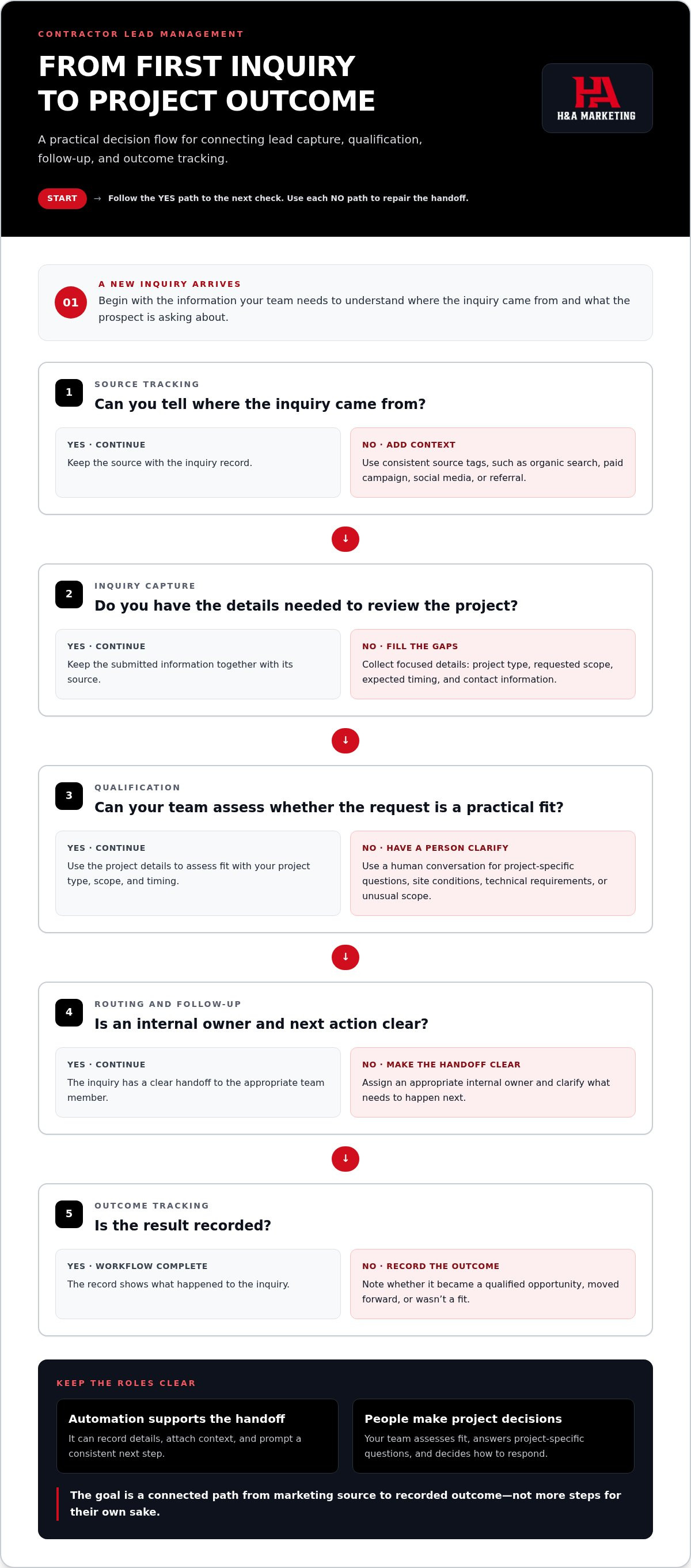
A useful workflow follows an inquiry from its first marketing touchpoint through to a recorded outcome. The aim is to preserve context at each handoff, so your team can see where interest started, what the prospect needs, and what happened next. That’s the practical core of marketing automation for contractors: connect the steps, while keeping people responsible for decisions and conversations.
- Marketing source: Note whether someone found you through organic search, a paid campaign, social media, or a referral.
- Inquiry capture: Collect the submission and its source through a website form or another defined contact point.
- Qualification: Gather enough project information to assess fit, such as project type, scope, and expected timing.
- Routing: Assign the inquiry to an appropriate internal owner and make the next action clear.
- Outcome tracking: Record whether the inquiry became a qualified opportunity, moved forward, or wasn’t a fit.
This sequence helps pinpoint gaps. If inquiries arrive but aren’t assigned, improve routing. If your team can’t tell which channels bring suitable opportunities, make source tags and outcome records more consistent. The goal isn’t to add steps for their own sake, but to connect information that would otherwise remain scattered.
What belongs in the contractor lead-capture process?
Ask for details that help your team understand the project and respond appropriately. Depending on the work you take on, that may include project type, a short description of the requested scope, timing, and contact information. Keep the form focused. A clear, manageable first interaction helps prospects explain what they need without turning an initial inquiry into a lengthy questionnaire.
Campaign-specific forms can connect a prospect’s inquiry to the message or service that prompted it. A focused page for a particular offering, supported by clear construction landing pages, gives visitors a relevant place to take the next step. Use source tags consistently, so search, paid campaigns, social activity, and referrals don’t all end up grouped under a vague label like “website.”
How automation and a CRM work together
A CRM organizes contact and opportunity records; automation carries out defined tasks using information from those records. For example, a form submission can create or update a contact, attach the source and project details, and notify an assigned team member. That person can review the inquiry and decide how to respond. The system supports the handoff, while staff handle judgment and personal follow-up.
Keep the scope clear. This workflow covers capture, qualification, assignment, and outcome visibility, not a detailed sales follow-up sequence. Longer-term lead nurturing needs its own communication plan. If your website needs a clearer inquiry path, H&A Marketing’s construction website design can support a more connected capture process.
How to compare contractor marketing automation tools and integrations
Compare tools against the workflow your business needs, not the length of a feature list. Trace how a prospect moves from a marketing touchpoint to an inquiry, an assigned owner, and a recorded outcome. Then assess whether a platform connects those steps with the tools you already use. This keeps marketing automation for contractors focused on practical handoffs rather than adding software for its own sake.
Use this scorecard to compare options side by side:
- Workflow fit: Can it support your actual process from campaign response to inquiry review and opportunity tracking?
- Existing tools: How would it work with your website forms, CRM, SEO reporting, Google Ads, and Meta Ads?
- Reporting: Can your team retain useful source information and see inquiry status through the handoff?
- Usability: Can the people responsible for reviewing leads understand and use the workflow without unnecessary steps?
- Ownership: Is it clear who maintains the process, checks data quality, and handles issues when a handoff fails?
The right fit is the system your team can actually use. Before choosing, review current details such as integrations, plan limits, and platform features. A feature name alone doesn’t show how it will work with your setup.
Which integrations matter to a construction business?
Prioritize connections that reduce repeated entry between inquiry forms and contact records. A useful handoff keeps project details and source information attached as an inquiry moves into the CRM. Check that your reporting process can still show where the inquiry came from and what happened to it. Treat an integration as essential when it supports a real workflow; set aside features your team is unlikely to use.
How to avoid adding another disconnected marketing tool
Before adding software, inventory your current systems. Note where the same contact is entered more than once, where staff manually transfer details, and where campaign source or inquiry status gets lost. Then assign an internal owner to oversee the workflow and keep records consistent. A tool without clear ownership can create another place for information to drift instead of making the process clearer.
Connections matter across the marketing path. Website forms, SEO activity, Google Ads, Meta Ads, and CRM records should support a shared view of inquiry source and progress, even if each channel has a different role. Coordinated construction lead generation can align marketing activity with lead capture, giving your team better context to evaluate opportunities. If a handoff is breaking down, map the systems and steps you already use to find where information gets lost.
How contractors can implement marketing automation without overcomplicating it
Keep the first version small. A practical rollout for marketing automation for contractors begins with one recurring point of friction, not a plan to automate every customer interaction. Choose a workflow your team can explain, test it under real conditions, and expand only when the basic handoff works.
Choose the first workflow around a real business bottleneck
Look for an inquiry that gets missed, delayed, entered twice, or separated from its marketing source. Pick one repeatable task with a clear owner and an observable finish, such as logging and assigning a new website inquiry. Avoid starting with a complex sequence across multiple channels. If the capture and ownership process is unclear, extra automated steps can make the confusion harder to spot.
Before making changes, establish a baseline from the records you already have. Note what you can reliably track, such as inquiry source, whether key project details are present, whether an owner was assigned, and the eventual opportunity outcome. If information is missing, record that as part of the starting picture rather than filling gaps with assumptions. This gives your team a fair way to assess whether the workflow is becoming more consistent.
Then use a simple implementation sequence:
- Choose one bottleneck: Define the specific administrative problem you want to address.
- Map the current process: Write down how an inquiry arrives, who handles it, and where information gets lost or repeated.
- Configure the workflow: Set up only the capture, assignment, notification, or recordkeeping steps needed to address that issue.
- Test the handoff: Submit a test inquiry and confirm the information reaches the right place and person.
- Review and refine: Compare the new process with your baseline, then adjust before adding another workflow.
Test, review, and improve the workflow
Test more than the ideal path. Check that required details appear in the correct record, the internal owner is clear, and the inquiry isn’t duplicated as it moves between systems. Review actual records regularly for missing project information, duplicate entries, or inquiries routed to the wrong person. A workflow is useful only if the information stays accurate and staff can act on it.
Measure what the process can reasonably show: whether inquiries fit your project types and scope, whether the response process is followed, whether handoffs are completed, and what outcomes are recorded. Don’t judge success by message volume alone or assume a new workflow will automatically improve project results. Use the evidence to identify what’s working and what still needs attention.
Keep longer-term communication over a project’s buying cycle as a separate planning task. Lead nurturing requires its own decisions about useful content and appropriate follow-up; it shouldn’t be added to an untested capture workflow. Start with the operational friction you can see, make that step reliable, then build deliberately.
How H&A Marketing connects automation to a contractor growth system
Automation is one part of a reliable marketing process. For custom home builders and construction companies, the wider system connects strategy, creative, traffic, and lead capture. That matters when a prospect is considering a high-value project and may take time to research, compare options, and decide whether to reach out. Software can organize information, but the marketing journey still needs a clear message and a useful next step.
Connect visibility, creative, and lead capture
A construction website should do more than look polished. It should explain the company’s work, present projects clearly, and make it straightforward for a prospective client to inquire. Thoughtful construction website design gives visitors a coordinated destination where the message, project presentation, and inquiry path support one another.
SEO, paid campaigns, and social activity can each introduce prospects to a business in different ways. When those channels point to relevant pages and consistent messaging, the inquiry arrives with more context. A campaign focused on a particular service, for example, should lead to a page that explains that service and invites a suitable inquiry, rather than sending every visitor to a generic destination. Source information can help the team understand which activity brought the prospect in, while CRM tracking organizes the inquiry and its progress.
That connection clarifies where information should flow. The marketing source provides context; the website captures the inquiry; the CRM organizes the contact and opportunity; and the team reviews fit and next steps. Each channel can have distinct content while contributing to a coherent experience and useful record.
Make automation part of a broader construction marketing partnership
H&A Marketing provides construction-focused services including website design, SEO, lead generation, social media management, branding, and visual content. Professional photography and video can present completed work clearly, supporting the creative behind a website or campaign. Automation can then help carry inquiry information into the right process, without replacing the expertise needed to shape the message or speak with a prospective client.
For a contractor, the goal isn’t simply to add another tool. It’s to build a connected marketing system where visibility, creative, traffic, and lead capture reinforce one another. H&A works with construction businesses to coordinate those pieces around their growth priorities. Marketing automation for contractors can support that system, while strategy and human judgment remain central to how it works.
Build a clearer path from inquiry to opportunity
Your next step doesn’t need to be a major technology overhaul. Choose one point in your marketing process where a clearer handoff or more consistent recordkeeping would help, then build from what your team learns. That keeps marketing automation for contractors tied to real business priorities, with people guiding the decisions that shape each project.
H&A Marketing partners with construction companies to connect marketing strategy with the work that supports visibility and lead flow. From your website and brand to search, lead generation, social media, and visual content, the focus is on creating a coordinated foundation your team can build on.
Start with a focused conversation about your goals, current challenges, and the next opportunity you want to pursue.
Frequently Asked Questions
What is marketing automation for contractors?
Marketing automation for contractors is software that carries out routine marketing or inquiry-handling steps according to rules your business sets. It doesn’t replace estimating or relationship-building. For example, after a commercial renovation inquiry arrives, a workflow could label its source, store the requested project type, and alert the person responsible for reviewing it. Staff still assess whether the scope suits the company and discuss project-specific details directly.
How can marketing automation help a construction company generate better leads?
Automation can make lead review more useful by preserving context about what a prospect needs and how they found the business. That gives staff a better starting point for assessing project type, scope, timing, and fit, rather than treating every submission alike. Teams can review unsuitable inquiries and refine campaign messages or intake questions. The system supports better decisions; it can’t promise more qualified leads.
What should contractors automate first?
Start with one repetitive task that has a clear beginning and finish, such as adding a source label to a new inquiry and notifying its assigned reviewer. Keep the first workflow limited to a single inquiry path, then test it with a sample submission. Confirm that the details appear where staff expect them and that someone owns the next action. Expand only after the process works consistently for your team.
Is marketing automation the same as a CRM?
No. A CRM is primarily the organized record of contacts, project opportunities, notes, and status. Automation is the set of rules that performs a task when a defined event occurs, such as creating a follow-up reminder after an inquiry is logged. A business may use CRM features and automation together, but the concepts differ: one keeps information structured, while the other helps move a process forward.
Can a small contracting business use marketing automation?
Yes. A small contracting business can use automation if it starts with a workflow that solves a real administrative problem and doesn’t demand more upkeep than it saves. For instance, a single intake path could capture inquiries from one source and make the responsible staff member clear. Keep fields and steps limited, review whether the process is still useful, and add complexity only when the team has a reason.
How does marketing automation work with a contractor website?
A contractor website can act as the front door to an organized inquiry process. A form can ask for information relevant to the work, while source details can show whether a visitor arrived from search, an ad, or another channel. With an appropriate workflow, the submission can be routed for staff review and its status recorded. Keep the form focused so a prospect can explain the request without unnecessary friction.
How should contractors measure marketing automation performance?
Track whether inquiries include useful project details, whether a suitable team member receives them, how often records are complete, and whether opportunities progress to a meaningful outcome. Compare these measures with your own starting records, not a generic benchmark. Also look for operational issues such as duplicate contacts or missing source labels. Reviewing a sample of records regularly can show whether the workflow is dependable and where it needs adjustment.
