

Article by
Harry Stanley III
Harry Stanley III is a construction marketing strategist and fractional CMO at H&A Marketing. He has helped construction companies grow through website strategy, SEO, paid advertising, branding, lead generation, CRM systems, and professional content. His past work includes helping Meraki Solar generate an additional $3.7 million in revenue in his first year and supporting American Builders as a fractional CMO. Today, Harry works directly with custom home builders and construction companies to build marketing systems designed to generate qualified leads and measurable growth.
Commercial roofing logo and brand design should make the company name easy to read, signal commercial expertise, and work across proposals, vehicles, uniforms, and digital materials. A simple wordmark, an image, or a combination can all work; keep the palette to no more than three colors and make sure the logo remains clear on different backgrounds. The right choice depends on the work you want property owners and facility managers to remember you for.
A logo can look professional yet feel too generic to distinguish a commercial roofer from a residential contractor or guttering business. That difference matters when a property owner scans a proposal, vehicle, or website to decide whether your company fits a restoration or replacement project.
This article explains how logo styles and branding choices can distinguish a commercial roofing business, what makes an identity practical and recognizable, and how to apply it consistently across marketing materials. You’ll also learn how to shape a brand around the commercial projects you want to attract, without relying on roof icons and familiar colors alone.
Key Takeaways
- Choose visual cues that reflect the commercial roofing work you want property owners and facility managers to associate with your company.
- Build a consistent brand around a few qualities you want customers to remember, then carry those choices through proposals, vehicles, uniforms, and digital materials.
- Decide whether your company name, a graphic, or a combination best communicates your roofing expertise at a glance.
- Make the difference between commercial and residential services clear through the identity’s wording, imagery, and overall tone.
- If you offer both roofing and guttering, shape the brand so each service is recognizable without making the business feel disconnected.
Want your own roofing logo?
An effective commercial roofing logo makes your company name easy to read and connects its identity with the work you want to win. It should remain recognizable on a proposal, vehicle, uniform, and website, where property owners see it at different sizes and against different backgrounds.
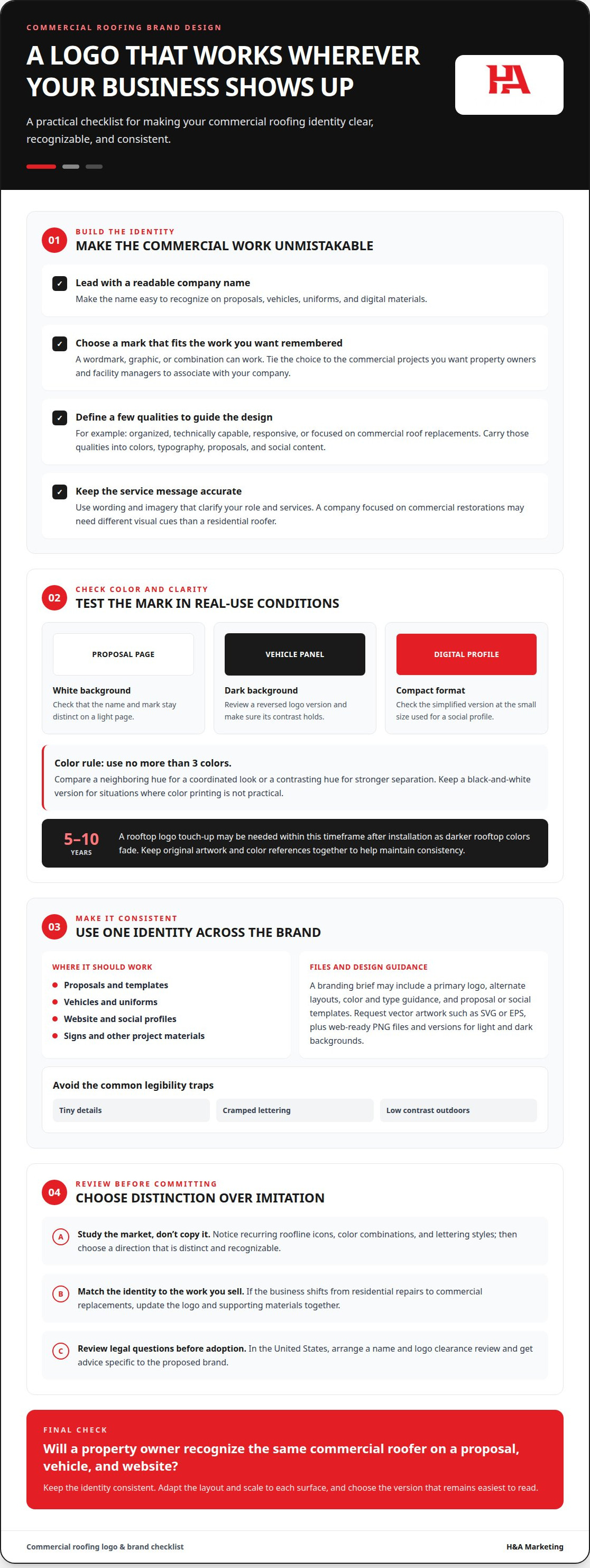
Choose colors by testing how they work in actual marketing materials, not just on a screen. Place a draft logo on a white proposal page, a dark vehicle panel, and a colored background. Roofing businesses are advised to use no more than three colors, which helps keep the design manageable across those applications. A black-and-white version can also keep the mark usable when color printing isn’t practical.
Use a color wheel to compare relationships between hues. Start with a primary color that fits the impression you want your company to make. Then test a neighboring hue for a coordinated look or a contrasting hue for stronger separation. For example, a blue wordmark with a contrasting accent can distinguish the company name from a simple roofline symbol. Review the complete mark at the sizes used on proposals and social profiles.
Logo colors and custom-colored roof coatings serve different purposes. A logo is a brand graphic; a coating is a roof finish. If a property owner is considering a distinctive coating color, discuss how it relates to the building and surrounding materials. Keep the contractor’s logo separate from the coating choice unless the project specifically calls for a rooftop graphic.
Plan for color changes over time. Darker rooftop colors can fade, and a rooftop logo touch-up may be needed between five and 10 years after initial installation. For building owners, the original contrast and placement affect how easily the mark can be refreshed. For contractors, keeping the original artwork and color references together helps maintain consistency across project materials.
Before final approval, test each logo variation in context. Check the full-color mark on a white proposal, a reversed version on a dark background, and a compact version on a digital profile. If the company name becomes hard to read, simplify the layout or adjust the color contrast. A construction website design should also present the identity clearly on desktop and mobile screens.
Keep colors consistent across sales materials, while using the logo version that reads best in each setting. A property owner should recognize the same contractor on a restoration proposal, vehicle, or website, even when the background changes.
Roofing company branding
Your roofing company’s identity should help property owners recognize its services and remember its name. Choose a few qualities you want customers to associate with the business, such as being organized, technically capable, responsive, or focused on commercial roof replacements. Use those qualities to guide the logo, colors, typography, proposal design, and social media content.
Choose a graphic designer or branding agency by reviewing identity work in practical formats, not just polished logo mockups. Look for examples of a design on a truck door, proposal cover, uniform, and website header. The right partner should be able to explain how design choices support your commercial audience and provide a consistent set of usable files.
Reviewing competitors can reveal familiar visual patterns, but don’t copy another roofing company’s logo or name. Look for repeated roofline icons, color combinations, and lettering styles in the market. Then choose a distinct direction, such as a clean geometric mark for a company focused on industrial roof restoration. Aim for recognition, not resemblance.
Rebranding makes sense when your current identity no longer matches the work you sell. A company shifting from residential repairs to commercial replacements, for example, may find that its house-shaped logo sends the wrong signal. Update the visual identity as a coordinated system: logo, typography, colors, proposal templates, vehicle graphics, and social media profiles. That keeps the business consistent as its market focus changes.
A roofing sales company’s logo should clarify its role without implying that it performs work it doesn’t. Use the company name and a concise, accurate description of its services. For a contractor selling commercial restorations, imagery tied to larger buildings or roof systems may be more relevant than a house silhouette.
For U.S. trademark and legal questions, arrange a name and logo clearance review before adopting a new identity. Similar names or marks can create conflict, so get advice specific to the proposed brand rather than assuming a different graphic makes a name safe.
Branding package contents depend on the project’s scope. A useful brief may cover a primary logo, alternate layouts, color and type guidance, and proposal or social media templates. Request vector artwork such as SVG or EPS, along with web-ready PNG files and versions for light and dark backgrounds.
In the United States, branding cost depends on the project’s scope and is provided after a quote request; research, design development, and required brand materials all shape the cost. To use one logo across vehicles, uniforms, signs, and websites, keep the artwork consistent while adapting its layout and scale for each surface. Avoid tiny details, cramped lettering, and colors that lose contrast outdoors.
Regional preferences can influence familiar colors and imagery, so consider the buildings, customer types, and competitors in the markets you serve. On social media, use the same profile mark and visual style for project photos, restoration updates, and facility-focused posts. A coordinated construction branding approach can help align those touchpoints.
Choosing text, imagery, or a combination
A roofing contractor’s logo can use the company name alone, an image alone, or both together. Choose the approach that communicates the business clearly where prospects encounter it, from a proposal cover to a vehicle door. A strong design isn’t defined by the number of symbols it contains. It’s defined by whether property owners can identify the company and connect it with the work it performs.
A wordmark puts the company name first. It can suit a contractor with a distinctive name or a commercial focus that needs to be stated plainly. For example, a company called Summit Roof Systems could emphasize its name without adding a stock roof icon. This approach keeps attention on the business and gives sales materials a clear, consistent signature.
A symbol-only logo can work when the mark is distinctive and familiar to its audience. For a new roofing business, however, a standalone abstract shape may not tell a property owner what the company does. One practical option is to pair the symbol with the full name on proposals and vehicles, then use the symbol alone in compact spaces such as a social profile image.
A combination mark joins the name with a graphic. Consider a commercial contractor whose logo pairs its name with a simplified warehouse roof outline. In a crowded market dominated by generic house icons, imagery associated with larger buildings can make the mark a better fit for commercial roofing at a glance. Keep the graphic simple enough to reproduce clearly on different materials.
Choose imagery based on your company’s actual work. A steep residential roof silhouette may suggest shingle replacement, while a flat-roof outline may better suit a business centered on commercial restorations. A gutter shape can be appropriate when gutter work is a meaningful service. Avoid crowding the graphic with rooflines, tools, buildings, and multiple service symbols.
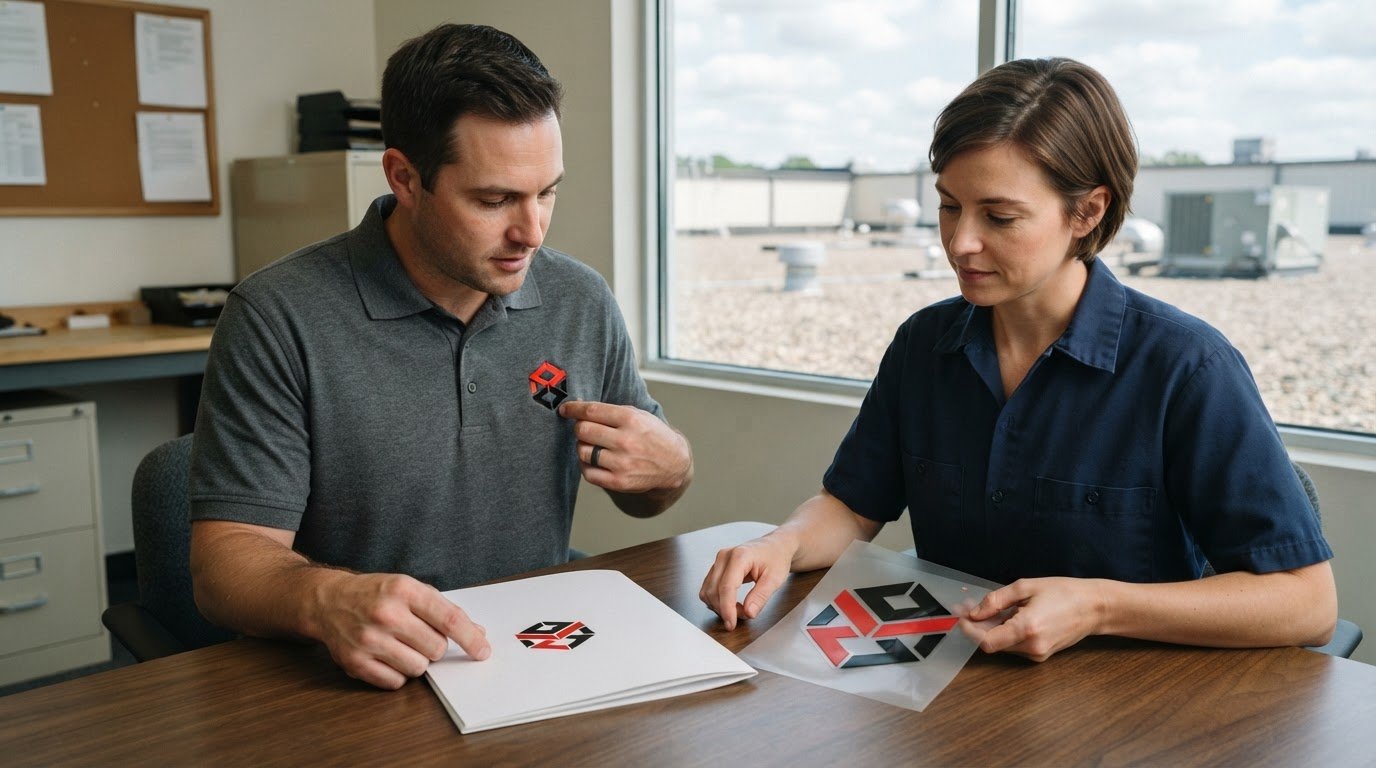
Test the design in real layouts before approving it. Place the name-only version on a proposal header, the combination mark on a vehicle panel, and the symbol in a small profile circle. If the company name is hard to recognize in any example, adjust the layout or use a more suitable version. Each application should look like the same business, not a different contractor.
Make your final choice with the company’s sales goal in mind. A contractor seeking facility managers may prioritize a direct name and a commercial building cue. A business serving several roofing markets may prefer a flexible mark that doesn’t overstate one service. In either case, the logo should help the right audience understand who the company is before reading a long description.
Commercial versus residential roofing logos
The difference should show up in more than the logo. Commercial roofing logo and brand design should support how a property owner evaluates a contractor, from the first impression through proposal review. Residential marketing often speaks to an individual homeowner. Commercial outreach may address property owners, facility managers, or others involved in evaluating a building project. Your identity and supporting materials should speak to the audience you want to reach.
Start with the service message attached to your brand. A contractor pursuing commercial restorations can make that focus clear on its proposal cover, website navigation, and company description. A residential contractor may organize its message around homeowner needs instead. Each audience should quickly understand whether the business handles the projects they’re considering.
For example, a company may perform both residential repairs and commercial replacements. If its materials use one general statement for every prospect, a facility manager may struggle to understand the commercial offer. Create distinct service descriptions and proposal introductions while keeping a shared company identity. This makes communication clearer without presenting the two markets as unrelated businesses.
Match project information to the buyer’s decision. A commercial prospect may want to understand the building type, work scope, and project process. A homeowner may focus on a specific residence and the proposed work. Organize case examples and project details so each audience sees relevant information, rather than sending every prospect through the same presentation.
Consider how your brand appears in a bid setting. Commercial roofing logo and brand design should stay consistent across the proposal cover, project summary, and follow-up materials. Use section labels that describe the work under consideration, such as restoration or replacement. This gives the identity a practical role in the sales process: helping prospects connect the company name with a clearly defined service.
A contractor moving toward a larger commercial pipeline may need to update more than its outward-facing message. Review how sales staff introduce the business, how proposals describe project scope, and how the website organizes services. Aligning those touchpoints helps prevent mixed signals. The identity then supports a commercial position through repeated, useful communication, rather than relying on a single visual element.
If your business serves both audiences, map each service to the materials prospects receive. Keep the core identity steady, but tailor the language and project examples to each market. That distinction helps commercial buyers assess the relevant offer without obscuring the residential work the company also performs.
Before approving a brand update, ask whether a commercial prospect can tell which projects the company pursues from its proposal and service information. If not, refine those materials before changing the mark alone. A focused identity works when the brand message, sales tools, and project details all point toward the intended market.
Roofing and guttering brand design
A business offering commercial roofing and guttering needs one identity that connects both services without blurring their differences. Start with the company name as the shared anchor, then use service descriptions and page layouts to clarify the work. A property owner looking for a roof replacement should recognize the roofing offer, while a facility manager reviewing drainage concerns should find guttering just as clearly.
For example, a contractor may use one logo across its proposal, service vehicle, and website, then label separate pages “Commercial Roof Replacement” and “Commercial Gutter Systems.” When a business serves related needs with different sales conversations, keep the core identity consistent and organize service information distinctly. The result is a connected brand that helps buyers identify the relevant offer.
Develop the brand architecture before creating separate logos. Decide whether roofing and guttering are equal services or whether gutter work supports the main commercial roofing focus. If restorations and replacements lead the business, make those services prominent in the primary message. Guttering can remain visible in supporting copy and dedicated service materials without competing for the same attention.
Visual elements can reinforce the relationship. A simple roof edge paired with a drainage line may suggest both services, but avoid adding tiny downspouts, tools, buildings, and multiple roof shapes. Small details may disappear in a proposal header. A restrained symbol and clear company name are easier to use across printed bid documents, vehicle graphics, and digital pages.
Consider a contractor whose old materials mention roofing but omit guttering. Property owners may not see the full range of services. Update the proposal template, website navigation, and service descriptions using the same visual system. This makes communication clearer across sales touchpoints while the logo continues to represent the overall company.
For a company adding guttering to an established commercial roofing business, don’t make the new service look like an unrelated brand. Keep the same typography and core colors, then give guttering its own descriptive label and relevant project examples. A consistent construction branding approach can help connect those service materials under one company identity.
Review the complete system in practical settings. Place the shared identity on a commercial reroofing proposal, then view a guttering service page alongside it. Check whether the company name stays prominent and each service is easy to distinguish. A clear structure presents one capable contractor, not two disconnected businesses.
H&A Marketing: Logo Design & Branding
H&A Marketing helps commercial roofing contractors develop a brand identity that fits their restoration and replacement work. Turn to its Logo Design & Branding when your current mark feels generic, your business focus has shifted, or your visuals don’t carry consistently across sales materials.
A strong identity works best alongside a website that clearly presents your services. H&A Marketing can connect construction branding and logo design with Website Design, Search Engine Optimization, and Lead Generation, helping property owners recognize your company and find relevant project information.
If your brand no longer reflects the commercial work you want to win, contact H&A Marketing to discuss your next steps.
Make your next brand decision count
Your brand should support the commercial roofing work you want to pursue next. Treat the logo as part of that decision, not as a standalone graphic. Your company name, visual identity, website, and search presence should tell a consistent story to property owners evaluating a restoration or replacement contractor.
Thoughtful commercial roofing logo and brand design can align that story with your business focus. H&A Marketing offers Logo Design & Branding, Website Design, and Search Engine Optimization for contractors planning their next stage of growth. A useful starting point may be refreshing the identity, improving how the website presents commercial services, or connecting both.
If your current brand no longer reflects your goals, discuss what needs to change with H&A Marketing.
A clearer identity can give your team a stronger foundation for the commercial projects ahead.
H&A Marketing for Commercial Roofing Brand Design
H&A Marketing offers logo design and branding for commercial roofing businesses developing or refining their visual identity. Its services also include website design, search engine optimization, lead generation, social media management, and video and photo.
Turn to H&A Marketing when you’re ready to bring your roofing brand and marketing materials together. Its services can support your next steps, from creating a logo and website to managing social media and visual content.
Frequently Asked Questions
Should Your Logo Be Text, Images, or Both?
Choose the format that makes your company easiest to identify in its main sales setting. If prospects often hear your name through referrals, prioritize a readable wordmark that reinforces it. If the name is less distinctive, a supporting graphic can help with recognition. Before deciding, show each option without the company name to people unfamiliar with the business, then ask what they remember.
What is a good way to get inspiration for my logo?
Start with the buildings and projects your commercial roofing team knows well. A facility’s roof plan, panel pattern, or structural profile may suggest original shapes without relying on familiar clip art. Review your project photos and note forms that recur across restorations or replacements. Then list the traits you want the identity to express, such as precision or steady project coordination, and use them to guide design concepts.
What visual symbols and colors work best for roofing company branding?
The best choices support the message you want property owners to remember. A clean structural grid can suggest planning, while a simple roof seam can connect the mark to roofing work. Select colors based on the impression you want to create, then check that the combination remains distinct in grayscale. This reveals whether the design relies too heavily on color alone.
What are the steps to create a commercial roofing brand identity?
Build the identity in a clear sequence: define the commercial customers and projects you want to reach, write the central brand message, and develop logo concepts around it. Select typography and colors that support the same direction. Then apply the system to a proposal cover and service page. Revise anything that makes the business focus unclear, and document the approved choices for consistent future use.
