


Article by
Harry Stanley III
Harry Stanley III is a construction marketing strategist and fractional CMO at H&A Marketing. He has helped construction companies grow through website strategy, SEO, paid advertising, branding, lead generation, CRM systems, and professional content. His past work includes helping Meraki Solar generate an additional $3.7 million in revenue in his first year and supporting American Builders as a fractional CMO. Today, Harry works directly with custom home builders and construction companies to build marketing systems designed to generate qualified leads and measurable growth.
A click isn’t the result. For commercial roofing companies, Google Ads work best when targeting, bidding, and the landing page align to attract prospects for restorations and replacements, then guide them toward a qualified sales conversation.
Ad spend can disappear quickly when a campaign attracts the wrong searches. There’s no single cost per lead for every commercial roofing market. Costs depend on competition, keyword targeting, and how effectively the page turns a visit into a call or form submission.
This guide explains how commercial roofing Google Ads work, what affects lead costs, and how to choose a targeting area that fits your crews and sales territory. You’ll also learn how negative keywords reduce irrelevant traffic and how bidding connects to lead quality, tracking, and follow-up. The aim is to build a campaign around qualified opportunities, not clicks alone.
Key Takeaways
- Judge campaign performance by qualified commercial opportunities and customer potential, not clicks alone.
- Choose city or territory targeting around where your crews can serve and your sales team can pursue projects.
- Use negative keywords to filter searches that don’t match commercial roofing work.
- Connect bidding decisions to conversion tracking so campaign adjustments reflect real calls and inquiries.
- Prioritize searches that show intent for commercial restorations, replacements, and related roofing services.
1. Cost per lead and cost per customer benchmarks
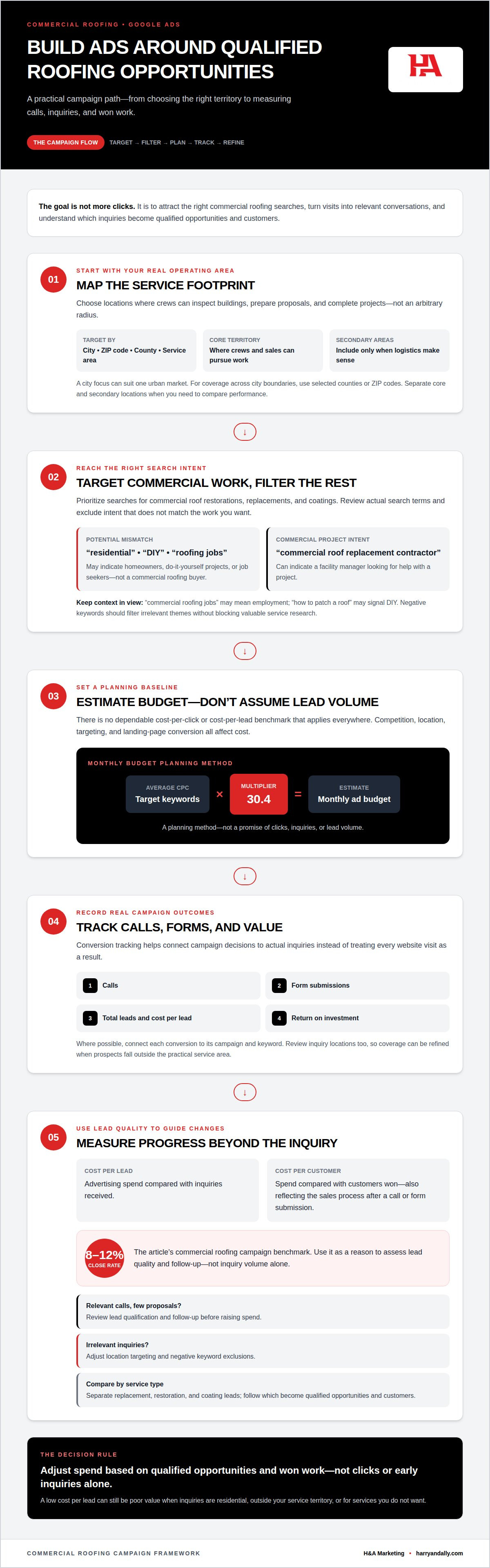
Commercial roofing Google Ads have no dependable cost-per-click or cost-per-lead benchmark that applies everywhere. Costs vary with keyword competition, location, campaign targeting, and landing-page conversion. A click is a traffic cost; a lead is a person or business that contacts you.
For budget planning, start with the average cost per click for the campaign’s target keywords. Multiply their combined average CPC by 30.4 to estimate a monthly advertising budget. Treat that as a planning method, not a promise of lead volume: clicks can produce different results depending on search intent and conversion performance.
Cost per lead measures advertising spend against inquiries received. Cost per customer measures spend against customers won, so it also reflects the sales process after someone submits a form or calls. Commercial roofing campaigns have an 8%-12% close rate benchmark. That makes it essential to assess lead quality and follow-up, not just inquiry volume.
For a meaningful comparison, separate leads for commercial roof replacements, restorations, and coatings. Track which inquiries become qualified opportunities and which turn into customers. A low cost per lead can still represent poor value if inquiries concern residential work, projects outside your service territory, or services you don’t want.
Set up conversion tracking for calls, form submissions, total leads, cost per lead, and return on investment. Where possible, connect each conversion to its campaign and keyword. This helps you see whether a search for commercial roof restoration leads to a genuine sales conversation, rather than counting every website visit as a result.
Budget decisions should follow those records. If a campaign attracts relevant calls but few proposals, review lead qualification and follow-up before raising spend. If irrelevant searches account for inquiries, adjust targeting and exclusions. Tracking lead generation for construction companies also helps connect advertising activity with the broader pipeline.
Use customer value and your sales process to judge what you can afford. A commercial replacement inquiry may require a site review, proposal development, and continued follow-up before a decision. Compare campaign costs with qualified opportunities and won work over time. Don’t judge performance on clicks or early inquiries alone. This gives budget changes a business rationale, not a guess.
There is no single reliable cost-per-click or cost-per-lead amount; both vary with competition, location, targeting, and conversion performance. Estimate a monthly budget by multiplying the average CPC of the target keywords by 30.4, then track actual spend against inquiries to calculate cost per lead.
How a professional chooses city-based or territory-based targeting for commercial roofing Google Ads
Start with your actual service footprint, not an arbitrary radius. Google Ads can target specific cities, ZIP codes, counties, and service areas. These options help commercial roofing companies focus ads on places where crews can inspect buildings, prepare proposals, and complete projects.
City-based targeting suits a business focused on one urban market. If you serve commercial properties within a particular city, concentrate the campaign there instead of reaching far beyond your operating area. A clear geographic focus also makes it easier to assess whether inquiries come from your intended market.
Territory-based targeting works when your sales area crosses city boundaries. If you serve several counties, define coverage around those counties or selected ZIP codes. Check that the combined territory reflects crew capacity, travel expectations, and the locations your sales team can pursue consistently.
Your project mix also matters. A company pursuing large commercial replacements may include farther service areas if site visits and project logistics make sense. A team prioritizing restoration work near existing crews may keep targeting tighter. The map should support the work you want, not simply maximize reach.
Separate locations when you need a clearer view of campaign performance. One campaign can focus on a core service area while another covers secondary areas. This makes it easier to compare calls and form submissions by location, then adjust coverage based on whether inquiries match your commercial services and sales priorities.
Broad coverage can reach a facility manager outside your practical territory. But boundaries that are too tight can exclude a viable commercial property just beyond them. Review inquiry locations alongside campaign targeting to identify both issues and refine your coverage area.
Before launch, compare each selected city, ZIP code, county, or service area with your operating footprint. Distinguish core markets from secondary locations, especially if crew or sales capacity varies. This gives commercial roofing Google Ads a geographic structure tied to real operations and qualified opportunities.
How a professional uses negative keyword targeting for commercial roofing Google Ads
Negative keywords prevent ads from appearing for searches that don’t fit the business. For a commercial roofer, terms such as “residential,” “DIY,” or “roofing jobs” may signal the wrong audience. A professional reviews actual search terms and excludes irrelevant themes while preserving searches for commercial replacements, restorations, and coatings.
First, distinguish unwanted intent from valuable service research. Someone searching “commercial roofing jobs” may be looking for employment, not a contractor. “How to patch a roof” may indicate a DIY project. By contrast, “commercial roof replacement contractor” may come from a facility manager seeking project help.
Negative keywords need context. Excluding “repair” across an entire account could block a useful commercial roof repair inquiry. Check whether a word appears in relevant searches before excluding it. You can also organize negative keywords by campaign, so a residential exclusion doesn’t accidentally block a relevant commercial campaign elsewhere.
Search-term reviews can uncover new sources of wasted spend. If a flat-roof replacement campaign starts matching “flat roof materials,” consider whether that research intent fits your sales goal. When an irrelevant query appears repeatedly, assess its wording and add a suitable negative keyword. This approach responds to real search behavior instead of guesswork.
To identify spam leads, compare each call and form submission with its search term and campaign. A form asking about a residential leak, for example, may indicate a relevance problem. A commercial property inquiry with incomplete details may call for sales follow-up, not immediate exclusion. Tracking these differences helps preserve useful prospects.
Click fraud requires a different response from keyword cleanup. Negative keywords address search relevance, but they don’t identify every suspicious click. Review unusual activity alongside call records, form quality, and campaign patterns. If a source repeatedly produces low-quality interactions, investigate the evidence and use available account controls rather than assuming every poor lead is fraudulent.
Useful review questions include:
- Does the query describe a commercial building, roof system, or project?
- Does it suggest hiring a roofer, or finding a job, product, or tutorial?
- Did the call or form provide a plausible commercial project and contact?
These checks connect search intent with actual lead quality. For example, “commercial roof coating contractor” may fit a targeted campaign, while “roof coating training” may not. The professional preserves useful variations, removes clearly unrelated intent, and reviews the effect on inquiries before making broader changes.
This ongoing discipline matters because one exclusion can affect multiple searches. Careful review protects relevant terms and reduces avoidable traffic without treating every unusual click as fraud. For commercial roofing campaigns, each exclusion should serve a clear business purpose.
How a professional manages roofing Google Ads and pay-per-click bidding
Effective pay-per-click management connects campaign structure, bidding, and the landing page. For a commercial roofer, each should support a clear goal, such as generating replacement inquiries rather than general roofing traffic.
A professional builds a landing page around one commercial service and its search intent. A replacement page can explain the work, show relevant project photos, and provide a phone number, contact form, and clear next step. Google Ads landing pages should work well on mobile, load quickly, and display trust signals. A smartphone load time of no more than 3 seconds is recommended.
Google Ads, SEO, and Local Services Ads serve different roles in your marketing mix. Search ads can bring traffic after launch, while organic SEO can take months to rank. Keep service descriptions and target areas consistent across channels, then track each source separately. Treat Local Services Ads as a distinct lead source when available, not as part of Search campaign results.
Before launch, review Google Ads’ current policies and requirements. Ad copy and landing pages should accurately describe your roofing services and avoid unsupported claims or promises. Check both the ad and its destination, since approval and campaign delivery depend on meeting platform requirements.
Structure campaigns so performance is easy to understand. Separate campaigns by service and geography, then group closely related searches. For example, commercial roof replacement and roof restoration can have distinct campaign themes and landing pages. This makes it easier to see which service attracts inquiries and where prospects are located.
Choose bids according to the campaign objective and available conversion data. Focus on meaningful actions, such as calls and completed inquiry forms, rather than treating every click as a success. Account for lead quality, too: a form from a facility manager seeking a replacement is more relevant than an unrelated residential inquiry.
Google Ads may place several roofing ads together in search results, so relevant messaging matters. Align the keyword theme, ad copy, and landing page. If an ad highlights commercial restoration expertise, its destination should clearly explain that service. This consistency shows prospects what to do next and makes campaign reporting more useful.
After launch, review search activity, conversions, and the quality of incoming opportunities. If a campaign attracts clicks but few useful inquiries, assess bidding, ad relevance, and page performance together. Base changes on evidence from calls and forms, not click volume alone, to keep the campaign focused on viable commercial roofing prospects.
What keywords should a professional target for commercial roofing Google Ads leads?
The most useful keyword targets reflect the service, building type, and buyer’s intent. “Commercial roof replacement,” “industrial roofing contractor,” and “commercial roof coating” describe specific work. A search for “commercial roofing company near me” may indicate local intent, while “commercial roof replacement cost” may signal early research rather than an immediate project request.
Group keywords by the work you want to sell. Replacement, restoration, flat roofing, and coating searches can each have relevant ad copy and a matching landing page. This keeps a facility manager searching for roof restoration from landing on a page focused only on replacement.
Service modifiers clarify search intent. Terms such as “commercial,” “industrial,” “warehouse,” and “flat roof” help distinguish commercial opportunities from residential searches. Assess which modifiers fit your actual services and target locations, and avoid broad terms that could attract unrelated traffic.
Search intent matters as much as the phrase itself. “Commercial roofing contractor” suggests someone looking for a provider. “Commercial roofing materials” may come from someone comparing products, while “roofing jobs” signals employment intent. Prioritize searches aligned with facility managers, property owners, and buyers evaluating a commercial project.
Match keyword choices to your sales pipeline. A contractor focused on restoration might prioritize “commercial roof restoration contractor” and “commercial roof coating company.” A team seeking replacement projects may build a separate theme around “commercial roof replacement” and “industrial roof replacement.” Separate themes make ad and landing-page relevance easier to assess.
Location terms add useful context when they match your target area. A city name combined with “commercial roof replacement,” for example, may signal a local project search. Align those terms with campaign geography rather than adding every nearby city to every keyword. Target searches should reflect where you can pursue work.
Keep refining keyword selection after launch. Review actual search terms and compare them with calls, form submissions, and sales qualification. If “commercial roof coating” brings relevant property inquiries, give it attention. If “roofing supplies” produces product-shopping traffic, consider a negative keyword or tighter targeting.
Broad traffic can look active without producing project opportunities. A coordinated commercial roofing marketing strategy keeps keyword decisions connected to the contractor’s services, target buyers, and sales priorities.
H&A Marketing
H&A Marketing helps commercial roofing contractors connect campaign strategy with the pages and follow-up that turn interest into qualified opportunities. If paid search brings clicks but few relevant inquiries, the gap may lie in landing-page clarity, service positioning, or lead capture.
H&A supports that foundation with website design, search engine optimization, lead generation, and logo design and branding. A commercial replacement page, for example, can clarify the service, guide facility managers toward an inquiry, and reinforce a consistent brand. These elements help your marketing work as a connected system, rather than a collection of disconnected tactics.
If you’re evaluating how to attract better-fit restoration and replacement opportunities, contact H&A Marketing to discuss your commercial roofing marketing needs.
Build the next campaign around the work you want more of
Review Google Ads search terms, calls, and form submissions with your sales team. Identify which inquiries are for commercial roof restorations or replacements that fit your services, and which are outside your target. Use that review to adjust keywords, ad copy, and landing pages.
Commercial roofing Google Ads can show how facility managers and property owners describe their roofing needs. Use relevant search terms and sales conversations to make your ads and landing pages clearer, while avoiding terms that attract unqualified inquiries.
Track qualified inquiries through follow-up and sales outcomes, not just clicks. Use what you learn to decide which campaigns to maintain or adjust, and where to focus your budget to pursue more suitable commercial roofing projects.
Reviewing campaign performance against project fit helps keep your marketing focused on the work you want.
Frequently Asked Questions
How do Google Ads work?
Google Ads lets businesses compete to show ads when people search for relevant services. You choose campaign goals, targeting, and bidding, then pay according to the campaign model. For a roofing contractor, a search about commercial roof replacement can prompt an ad. Reporting can show whether someone clicked or contacted the company. Ad relevance, landing-page fit, and follow-up shape what happens next.
What Are Roofing Google Ads?
Roofing Google Ads are paid advertisements that promote roofing services across Google’s advertising placements. A commercial contractor might focus an ad on roof restoration, replacement, or coatings, then direct prospects to relevant service information. The goal is to connect an active search with a useful next step, such as calling or submitting a project inquiry. Commercial campaigns should address facility managers and property owners, not blend into residential roofing offers.
What tools can a professional use to manage commercial roofing Google Ads campaigns?
Campaign management can connect Google Ads reporting with call tracking, website forms, and a CRM. Together, these tools help distinguish a click from an inquiry and connect that inquiry with later sales activity. For example, a roofing team can record whether a facility manager’s form submission leads to a site assessment or proposal. Consistent tracking matters more than adding tools without a clear purpose.
How do Google Ads work for commercial roofing companies?
Commercial roofing Google Ads can show service-specific ads to people searching for a contractor. A campaign focused on commercial restoration can direct prospects to a page explaining the work and its next steps. The sales team can then qualify the property, requested service, and project timing. Connecting the ad, page, and follow-up helps assess whether campaigns attract inquiries that fit your commercial work.
What is a good Google Ads budget for a commercial roofing company?
A useful budget is one your company can sustain while assessing relevant campaign activity. Consider keyword competition, target markets, project priorities, and your team’s capacity to handle inquiries. For example, if estimating capacity is limited, focus on a priority service instead of spreading spend across every roofing term. Base budget decisions on lead quality and sales capacity, not a generic industry figure.
How can commercial roofers target businesses by location and service area in Google Ads?
Commercial roofers can target specific cities, ZIP codes, counties, or defined service areas. If you serve multiple counties, distinguish your core territory from locations you serve selectively. This can help your sales team understand where inquiries originate and whether they fit your operations. Target places where you can pursue commercial projects instead of drawing the broadest possible map.
How do commercial roofing Google Ads results vary by city and season?
Results can differ by city because competition, targeting, and landing-page conversion performance vary. Target cities or territories where crews can serve and the sales team can pursue projects; no seasonal differences are established here.
