

Article by
Harry Stanley III
Harry Stanley III is a construction marketing strategist and fractional CMO at H&A Marketing. He has helped construction companies grow through website strategy, SEO, paid advertising, branding, lead generation, CRM systems, and professional content. His past work includes helping Meraki Solar generate an additional $3.7 million in revenue in his first year and supporting American Builders as a fractional CMO. Today, Harry works directly with custom home builders and construction companies to build marketing systems designed to generate qualified leads and measurable growth.
A profile that attracts the wrong jobs isn’t a win. A Google Business Profile for commercial roofers is the business listing customers see across Google Search and Maps, and it should clearly represent your commercial roofing work. Set its service area to match the places your crews actually serve, then keep your contact details, hours, and project photos current.
If you focus on roof restorations and replacements, facility managers and property owners should be able to find a credible business that handles this work. Visibility alone isn’t enough: your profile also needs to show what kinds of roofing projects you take on and make it easy for prospects to contact you.
This guide explains how to choose a service-area or storefront setup, strengthen local visibility and trust, build a steady review presence, and keep business information consistent. It also covers how profile updates and real commercial project photos can strengthen your local presence without blurring your focus.
Key Takeaways
- Set your service area to match where your crews actually work, and choose a profile setup that reflects how customers reach your business.
- Build reviews steadily and respond to feedback to strengthen trust with facility managers and property owners.
- Use real commercial roofing project photos and relevant profile updates to show the work you want to win.
- Keep your business name, address, phone number, and other contact details consistent across directory listings.
- Complete your profile with accurate categories, hours, services, and contact information so prospects can understand your commercial roofing focus.
1. How should a roofer set up service area versus storefront?
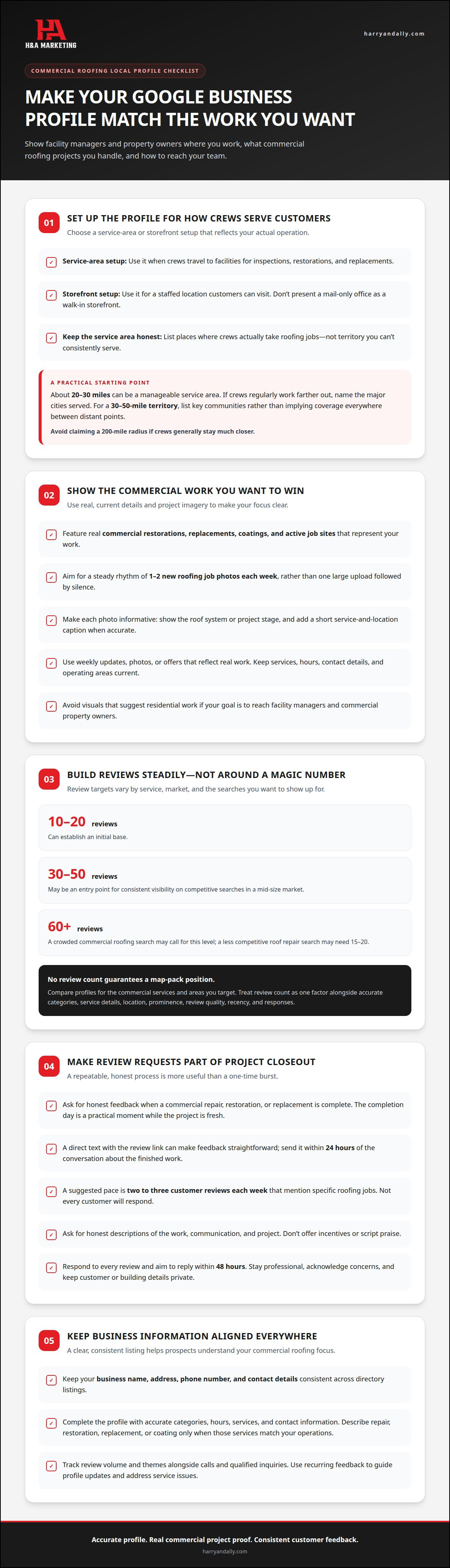
A commercial roofer needs a profile that reflects how customers are served. A service-area setup fits crews that travel to facilities for inspections, restorations, and replacements. A storefront setup fits a staffed location customers can visit. Choose the model that matches your operations, not an office address used only for mail.
For eligibility and setup, represent a real roofing business that serves customers at a business location or travels to their properties. If customers don’t visit your office, don’t present it as a walk-in storefront. Set the service area to places where your crews actually take roofing jobs, rather than implying coverage you can’t consistently provide.
A manageable service area of about 20–30 miles can be a practical starting point. If crews regularly serve farther locations, list the major cities where they work individually. For example, a contractor covering several communities across a 30 to 50-mile territory can name the main places served instead of suggesting coverage everywhere between distant points. Avoid claiming a 200-mile radius if crews generally stay much closer.
Use real project photos to show the commercial work you want to attract. Include completed roof restorations, replacements, coatings, and active job sites where images clearly represent your work. Add team photos and a recognizable office image when they help property owners identify your business. A useful rhythm is 1–2 new roofing job photos each week, rather than uploading one large batch and leaving the profile untouched. Commercial roofing photography and video can help present projects clearly.
Make each photo informative. Show the roof system or project stage, and add a short caption naming the service and location when accurate. A photo of a completed commercial restoration in a served community gives prospects more context than a generic roofing image. Avoid visuals that imply residential work if you want to attract facility managers and commercial property owners.
Keep service details aligned with the work your crews perform. Describe commercial roof repair, restoration, replacement, or coating only when those services match your operations. Use plain language to explain your commercial focus. Accurate services, real project photos, and a genuine service area help Google and prospects understand your profile. They support relevance, but no profile detail guarantees a map-pack position.
Keep the listing active with weekly updates, photos, or offers that reflect real work. A post might feature a completed replacement, explain a restoration service, or note that a crew is working in a listed community. Update details when operating areas, phone numbers, or hours change. Current information helps prospects decide whether to contact your roofing team.
2. How many reviews does a roofer need to compete in the map pack?
There’s no single review count that guarantees a map-pack position. As a practical benchmark, 10 to 20 reviews can establish an initial base, while 30 to 50 reviews may be an entry point for consistent visibility on competitive searches in a mid-size market. The right target depends on local competition, the roofing service, and the search being made.
Competition varies by query and service area. A less competitive roof repair search may need 15 to 20 reviews for map-pack placement. A crowded commercial roofing search may call for 60 or more. Compare the profiles appearing for the commercial services and areas you target, then build a steady review pace rather than chasing a fixed national number.
Review count is only one local visibility factor. Your primary category and service details describe what the business does, while location and prominence affect which searches fit. Reviews provide evidence of customer experience and may mention services, such as a completed commercial restoration. Keep the profile accurate, and treat review quality, recency, and response activity as reputation signals, not a ranking guarantee.
Make review requests part of the closeout process. Ask the customer for honest feedback when a commercial roof repair, restoration, or replacement is completed. The completion day is a practical moment because the project is fresh. A direct text with the review link can make leaving feedback straightforward; send it within 24 hours of the conversation about the finished work.
Consistency matters more than a one-time burst. A suggested pace is two to three customer reviews each week that mention specific roofing jobs. Not every customer will respond, so use a repeatable request process after completed projects. Don’t offer incentives or script praise. Ask customers to describe their honest experience of the work, communication, and project.
Answer every review, whether it’s positive or negative, and aim to respond within 48 hours. For a positive review, thank the customer and refer naturally to the completed work. For criticism, keep the response professional, acknowledge the concern, and offer a private way to discuss project details. Avoid sharing customer or building information publicly.
Track review volume and themes alongside calls and qualified inquiries. If customers repeatedly praise clear project communication, that can guide future profile updates. If concerns recur, address the underlying service issue before sending more requests. A coordinated local SEO strategy can connect review management with accurate profile details and relevant commercial roofing pages.
3. Using the profile to build local visibility and trust
A complete profile helps Google and prospective property owners understand your commercial roofing focus. Use a clear business description that names services such as roof restoration, replacement, and coatings. Add location terms only where you genuinely serve customers. For example, “commercial roof replacement in the communities your crews serve” describes an area your team actually covers, not a market you hope to enter.
Keep the description direct and specific. Explain who you serve, what work you handle, and which locations your crews cover. Review it quarterly so changes to services or operating areas don’t leave outdated claims. A facility manager should quickly see whether your company handles commercial properties, rather than infer your focus from a generic roofing description.
Local search visibility depends on several signals working together, including relevance, distance, and prominence. Accurate profile details help establish relevance, while reviews and consistent business information contribute to trust. The map pack is competitive, and a nearby competitor with clearer service details may better match a particular search. No single description or keyword can secure a placement.
Use local phrases naturally across your profile and relevant website pages. Pair a service with a real place in your operating area rather than repeating location names without context. A dedicated page about commercial restoration can explain the project process, building types, and service area, giving property owners useful detail when they click through.
A profile and paid ads serve different roles. The profile supports organic discovery and gives searchers a quick view of your business. Paid ads can put a specific offer in front of targeted searches while you build a longer-term local presence. Referrals and direct outreach also matter for commercial projects. Compare channels by qualified calls, estimate requests, and signed work, not visibility alone.
Measure profile activity by reviewing calls, messages, and website clicks, then connect each inquiry to its outcome. Record whether a caller manages a commercial property, asks about a restoration, or needs a replacement estimate. A basic lead log can show which inquiries become site visits and proposals. This connects profile engagement to your sales pipeline instead of treating clicks as the final result.
Local citations are directory listings that repeat key business details. Keep your business name, address, and phone consistent across regional directories, then correct old entries when information changes. Inconsistent details can confuse property owners comparing listings. A coordinated lead generation process can connect profile inquiries with follow-up and project qualification, helping your team assess which channels bring relevant commercial opportunities.
4. Keeping business information consistent across directories
A commercial roofing company can have listings across Google, regional business directories, and industry platforms. If one listing shows an old phone number while another displays a different business name, a property manager may hesitate before calling. Keep core details consistent wherever your company appears, including its official name, address or location details, phone number, and website.
Start with one internal record that holds the approved version of each detail. Use the exact business name customers see on your signage and proposals. Record the main phone number, website address, and location information used for public listings. When a phone line changes, update that record first, then use it to guide corrections across every directory.
A practical directory audit is a comparison, not a rewrite. Search your company name and review each listing against the approved record. Track the directory name, current details, corrections needed, and update status in a spreadsheet. Check regional directories where facility managers or commercial property owners might find contractors, along with listings that appear for searches like “commercial roofer near me.”
- Compare the business name, including spelling, punctuation, and any location wording.
- Match the phone number to the line your roofing team answers for project inquiries.
- Review the address or location details against the information used on your profile.
- Check the website link and replace outdated pages or broken destinations.
Keep location information accurate without confusing an office with a service territory. For example, a listing should not imply that a crew works from a city where the company has no operating presence. If your service footprint changes, update location details consistently across profiles and directories. A large radius on one listing can’t clarify conflicting location information.
Business changes often create duplicate or outdated listings. A rebrand, office move, phone-system change, or website redesign can leave old details online. Add these events to your update process: identify affected directories, correct the information, and mark each correction complete. If an old listing remains, avoid creating another version with slightly different contact details.
Consistent citations support a clear local SEO foundation, but directory accuracy also helps people reach the right team. A facility manager searching for a commercial roof replacement shouldn’t encounter a residential-only phone line or an obsolete office address. Review the record whenever key contact details change, and include directory checks in the same workflow as profile updates. This keeps your public identity aligned across listings, rather than leaving prospects to guess which version is current.
5. Claiming and optimizing a Google Business Profile
Claim the profile for the real roofing business customers contact, then complete its fields with accurate details. Use a storefront setup only when customers can visit that location; use a service-area setup when crews travel to customers. Don’t present a virtual office used only for mail as a customer-facing storefront.
Choose “Roofing Contractor” as the primary category, then add only relevant services the company actually performs. Commercial roof replacement, restoration, coatings, and repair can clarify the profile’s focus when they match your work. Don’t add unrelated services just to appear in more searches. Google Maps users should see a clear match between the category, services, and commercial roofing projects.
Build the business description around the customer’s decision. Google allows up to 750 characters, so use that space to explain your commercial focus, key roofing services, and genuine operating locations. For example, describe replacement work for commercial buildings in places where crews serve clients. Avoid repetitive keywords, unsupported claims, or a list of locations outside your real service area.
Complete the profile fields that apply to your business, including current hours, phone, services, and location details. Add real job photos that show commercial roofing work, not stock images or projects completed by another company. A profile can showcase completed restorations and replacements alongside team or office photos. Google reports that businesses with complete profiles get 7 times more clicks than businesses with incomplete profiles.
Common profile problems include inaccurate business names, misleading addresses, duplicate listings, and details that don’t match the company’s actual operations. These inconsistencies can confuse customers and may lead to profile restrictions. Keep the public name aligned with the real business, represent locations honestly, and avoid creating extra profiles for the same operation without a distinct business location.
After claiming the profile, review it whenever business details change. Seasonal hours, new services, or a changed phone line can make an otherwise polished listing inaccurate. Keep the description focused, services current, and photos representative. A Google Business Profile for commercial roofers supports local visibility, but competition and a searcher’s location also affect ranking.
Claiming and maintaining a Google Business Profile is free. Pair accurate profile details with useful commercial roofing pages and a consistent marketing plan. If you want help connecting those pieces, explore commercial roofing marketing with H&A Marketing.
H&A Marketing
H&A Marketing helps commercial roofing contractors connect their Google Business Profile with the rest of their marketing. When profile details, local search visibility, and lead follow-up feel disconnected, a coordinated plan can make each part clearer and more useful to prospective customers.
That work can include Search Engine Optimization, relevant website pages for commercial restorations and replacements, and lead generation focused on qualified project inquiries. Website Design and Logo Design & Branding can also help present a consistent business identity wherever facility managers find your company.
If you’re ready to make your profile part of a stronger commercial roofing marketing system, contact H&A Marketing to discuss your next steps.
Turn profile activity into a stronger project pipeline
Your next step is to connect profile activity with the commercial opportunities your team wants to pursue. Track whether inquiries relate to restorations, replacements, or other work you perform, then use that information to refine your marketing priorities. A Google Business Profile for commercial roofers works best as part of a wider presence, where search visibility, a clear website, and a consistent brand reinforce one another.
H&A Marketing can align Search Engine Optimization, Website Design, and Logo Design & Branding with your commercial roofing goals. This gives facility managers and property owners a clearer path from finding your company to understanding its work and making an inquiry.
Build from the profile you have today, then strengthen the next step in your growth plan.
Frequently Asked Questions
What is Google My Business?
Google My Business is the former name of Google Business Profile. People may encounter this business profile while using Google Search or Google Maps. For a roofing company, think of it as a compact public introduction: it can help a searcher recognize the business before deciding whether to call, visit its website, or consider another contractor. The name changed, but people still use the old term.
How do you handle the photos and videos for my profile?
H&A Marketing offers Construction Photography & Video services that can create visual assets for commercial roofing marketing. A useful project brief can identify the audience, the work to feature, and any sensitive facility details to avoid showing. For example, a shoot might capture both a wide view of a finished commercial roof and close details that explain the restoration work. The resulting content can support your profile and other marketing materials.
How do you write a description that includes keywords without sounding robotic?
Start with the customer and the business’s real specialty, then use search terms only where they clarify that specialty. For instance, a natural opening could say, “We help property owners plan commercial roof replacements and restorations.” Read the draft aloud: if a phrase sounds like a search query rather than something a contractor would tell a facility manager, rewrite it. Clear meaning should lead; keywords should fit the sentence.
How many reviews does a roofer need to compete in the map pack?
There’s no universal review total that guarantees a map-pack position. For a useful benchmark, look at the profiles appearing for the commercial roofing searches that matter to your business, then consider how established and relevant their reviews seem. Use that comparison to set a realistic internal goal. Review count is context for evaluating local presence, not a promise of visibility or a substitute for qualified project inquiries.
How often should the business description be updated?
Review the description quarterly, and revise it when the company’s services, audience, or operating details change. Compare its claims with your current commercial roofing proposals and service pages. If the profile says you handle a type of restoration your team no longer takes on, update the wording. Avoid rewriting accurate copy just to rotate keywords.
How should a roofer set up service area versus storefront?
Choose a service-area setup when customers hire crews to work at their properties; choose a storefront setup when customers visit a genuine business location. Consider the customer’s actual journey: does a facility manager schedule a site visit, or come to your office for a meeting? The answer helps distinguish a working customer location from an administrative address that isn’t open for visits.
Should a roofer mention specific roofing materials or roof types?
Yes, if naming a roof type helps a facility manager identify a relevant specialty your crews genuinely handle. Terms such as metal roofing or single-ply membrane can clarify the kind of commercial project you take on. Keep the description selective and accurate. Listing every system may blur your focus, while naming a system your team doesn’t service can create the wrong expectation.
What are Google Posts and why do they matter?
Google Posts are short updates published on a business profile. They give a contractor a place to share timely information, such as a seasonal roof-maintenance reminder or a note about a recently completed project. A useful post gives readers a clear reason to pay attention and a relevant next step. Treat posts as communication with prospective customers, not a guaranteed shortcut to higher rankings.
