

Article by
Harry Stanley III
Harry Stanley III is a construction marketing strategist and fractional CMO at H&A Marketing. He has helped construction companies grow through website strategy, SEO, paid advertising, branding, lead generation, CRM systems, and professional content. His past work includes helping Meraki Solar generate an additional $3.7 million in revenue in his first year and supporting American Builders as a fractional CMO. Today, Harry works directly with custom home builders and construction companies to build marketing systems designed to generate qualified leads and measurable growth.
More marketing activity doesn’t automatically mean more commercial roofing opportunities. Conklin contractor marketing works best when it connects visibility with a clear path from a facility manager’s first inquiry to a qualified restoration or replacement opportunity. The package price depends on its scope, including website work, SEO, advertising, project photography, lead capture, and follow-up.
It’s reasonable to want a straightforward package and a clear picture of where leads come from. But a list of services alone won’t show whether marketing attracts commercial buyers, captures their inquiries, and keeps the sales pipeline moving.
This article explains what to look for in a marketing package, which factors shape its price, and how lead generation fits into the larger system. It also shows why coordinated website content, search visibility, and timely follow-up matter when commercial roofing projects involve multiple decision-makers and longer sales cycles.
Key Takeaways
- See how marketing support can connect visibility, inquiry capture, and follow-up for commercial roofing projects.
- Understand which factors shape package pricing, from the work included to the channels being coordinated.
- Learn how to compare agencies by their approach to qualified leads and the sales pipeline, not just by a list of services.
- Explore what reported results can and can’t tell you about the marketing approach behind them.
- Get a clearer picture of the decisions and information that help a contractor begin with a focused marketing plan.
Marketing support and lead generation
For a Conklin contractor, marketing support can mean more than product information or a sponsor connection. It can also create a path from a facility manager’s roofing concern to a qualified sales conversation. These serve separate needs: technical support helps explain a roofing system, while lead generation helps the right commercial buyers find a contractor. A strong plan clarifies the handoff without suggesting that one automatically guarantees the other.
Claims about Conklin’s $80 million size and Robert Miller’s Sponsor ID 11796844 should be verified before they appear in marketing materials. Without reliable sourcing, they don’t establish the scale of the company or the nature of a sponsor relationship. A named contact may be useful to a contractor seeking Conklin-related support, but it doesn’t, by itself, explain how to attract building owners who need a restoration or replacement.
Marketing support is useful when it connects a contractor’s expertise with specific buyer needs. For example, a property manager searching for help with recurring leaks needs to understand what the contractor evaluates, which projects they handle, and how to start a conversation. Clear service pages and relevant project examples can answer those questions before the first call.
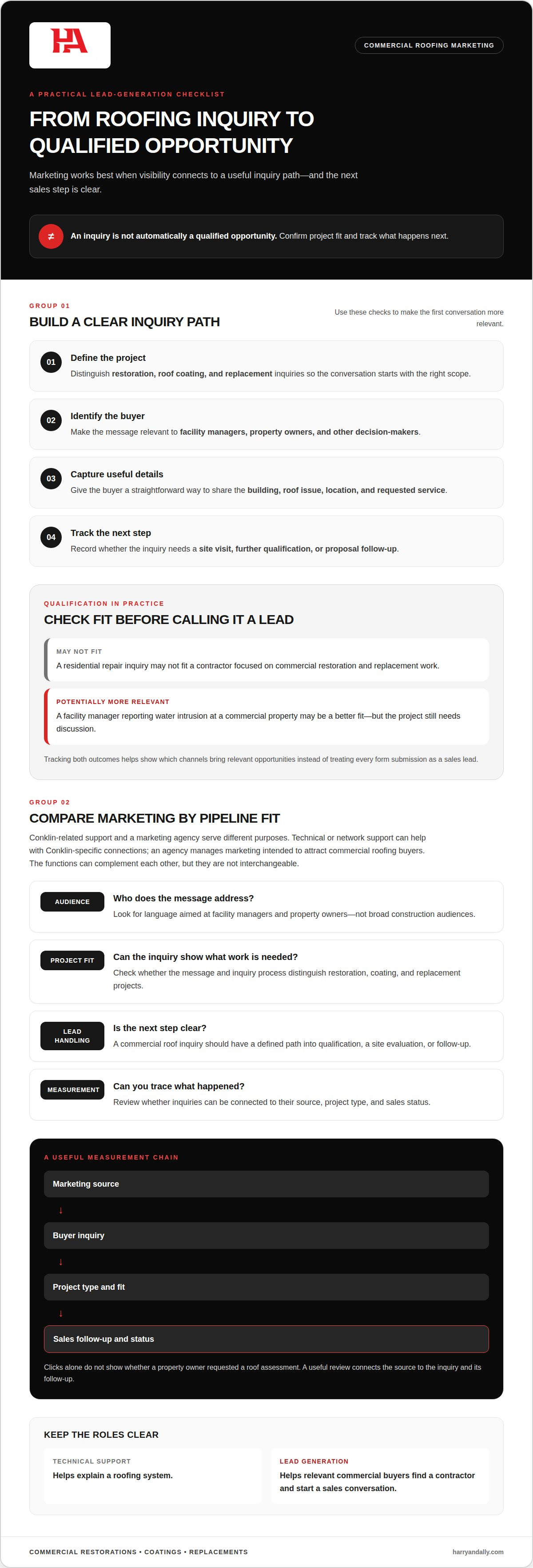
- Define the project: Separate restoration, roof coating, and replacement inquiries so sales conversations start with the right scope.
- Identify the buyer: Speak to facility managers, property owners, and other decision-makers in language that fits their concerns.
- Capture useful details: Ask about the building, roof issue, location, and requested service through a straightforward inquiry path.
- Track the next step: Record whether an inquiry needs a site visit, further qualification, or a proposal follow-up.
These steps help distinguish an inquiry from a qualified opportunity. Someone asking about a residential repair, for instance, may not fit a contractor focused on commercial restorations and replacements. A facility manager reporting water intrusion at a commercial property may be a better fit, but the project still needs discussion. Tracking both outcomes reveals which marketing channels bring relevant opportunities, rather than treating every form submission as a sales lead.
Claims about Jonathan Keim’s tenure leading Choice Roof Contractor Group for more than 12 years should also be verified before use. Without a reliable source, don’t present that detail as fact. Even if verified, it describes leadership experience within the group; it doesn’t establish an individual contractor’s track record or predict lead volume. Contractors should keep those claims distinct when describing their own work to buyers.
A testimonial describing a roof performing well for 20 years, with leaks appearing about 10 years after its warranty ended, should be verified before it is used. Without confirmation and context, don’t present it as an established customer story. Even when verified, it would be an individual account, not a forecast for every roof or a promise of service life. For marketing, explain project scope, documented experience, and the specific conditions behind a result.
To connect credibility signals with buyer outreach, contractors need a visible route from search or referral to inquiry and follow-up. A coordinated commercial roofing marketing approach can organize that path around the commercial projects a contractor wants to pursue.
How does Conklin contractor marketing compare with other agencies?
The comparison depends on what you need. Conklin-related contractor support and a marketing agency serve different purposes. A sponsor or contractor network may help with Conklin-specific connections. An agency builds and manages marketing to attract commercial roofing buyers. These functions can complement each other, but they aren’t interchangeable.
Start by identifying the gap in your sales pipeline. If prospects already know your company but need roofing-system information, Conklin-related resources may be relevant. If facility managers can’t find your business, or inquiries aren’t becoming qualified sales conversations, focus on marketing execution. A contractor pursuing commercial restoration work needs a path from buyer research to a useful inquiry, not just a recognizable product name.
A useful comparison of Conklin contractor marketing starts with the work each option handles. For a commercial roofing contractor, review how each approach connects buyer research with sales follow-up. A general campaign might generate form submissions without distinguishing commercial replacement inquiries from residential repair requests. A more relevant approach makes project type and buyer fit clear in both the message and inquiry process.
- Audience: Does the message address facility managers and property owners, or broad construction audiences?
- Project fit: Can the campaign distinguish restoration, coating, and replacement inquiries?
- Lead handling: Is there a clear next step after someone asks about a commercial roof?
- Measurement: Can you trace inquiries to their source and sales status?
These criteria show whether a provider focuses on activity or pipeline quality. A report showing clicks, for example, doesn’t tell you whether a property owner requested a roof assessment. A useful review connects the source, inquiry, project type, and sales follow-up. That distinction matters when a roofing proposal involves a site evaluation, internal approvals, and continued communication.
Also compare who coordinates each part. Separate providers may handle the website, search campaign, and lead response, leaving the contractor to connect the messaging, tracking, and sales process. A coordinated plan clarifies responsibilities. Identify what each team handles and how an inquiry moves between them. For example, decide who routes a facility manager’s replacement request and records its outcome.
Proof should support the claim being made. A Conklin-related testimonial may describe one roof’s history, but it doesn’t demonstrate an agency’s ability to generate qualified leads. Likewise, a marketing example should identify the contractor, project type, and work performed. Without those details, it’s difficult to judge whether the example applies to commercial restorations or replacements.
Compare prices by examining the scope behind each proposal, including strategy, campaign management, content, tracking, and follow-up responsibilities. A lower quote may cover fewer tasks, while a broader scope may connect more stages. Evaluate Conklin contractor marketing against your specific sales bottleneck, not just packages with similar labels.
For the search portion of that comparison, a commercial roofing SEO strategy should align buyer searches with relevant service pages and inquiry paths. That gives contractors a concrete way to assess whether their current marketing reaches the commercial buyers they want.
What results and case studies does Conklin report for contractors?
Roofing testimonials and contractor marketing case studies answer different questions. A roof testimonial describes an individual roof’s experience. A marketing case study should explain how a contractor attracted and converted commercial buyers. A roof performance claim, on its own, doesn’t show how marketing generated an inquiry, site assessment, or signed proposal.
That distinction matters when contractors assess Conklin-related results. A story about a roofing system may explain product use or customer experience. By itself, it cannot show how many qualified leads a contractor received or which outreach generated them. To understand marketing performance, look for a clear connection between an activity and a sales outcome.
A useful case study describes the starting point, the work performed, and the result. For example, a commercial roofer might document a campaign aimed at facility managers seeking roof restoration. The case should explain the message, where prospects encountered it, and how inquiries were handled. Without that sequence, a positive outcome lacks the context another contractor needs to learn from it.
- Project type: Identify whether the example concerns restoration, coating, or replacement.
- Buyer: Specify whether the inquiry came from a facility manager, property owner, or another decision-maker.
- Marketing activity: Describe the channel and message connected to the inquiry.
- Sales outcome: Distinguish a form submission from a qualified opportunity, proposal, or completed project.
Those details also prevent a common comparison mistake: treating every lead as equivalent. A request for residential repair differs from a commercial replacement opportunity. A report that combines both may not show whether a commercial contractor reached its intended buyers. Project fit, location, roof need, and sales stage add useful context to a lead total.
For a practical review, map each example from first contact through follow-up. Note whether the prospect found the contractor through search, a referral, or another channel. Then record the project type and what happened after the initial conversation. This turns a general success story into information a sales team can compare with its own pipeline.
Testimonials may be useful when they describe customer experience or a roof’s reported performance. Consider the specific claim each supports, rather than treating them as evidence of marketing effectiveness. A roofing outcome and a lead-generation outcome require different proof.
When reviewing a reported result, separate the evidence into three parts: what happened, what caused it, and what remains unknown about applying it elsewhere. For instance, an increase in a contractor’s inquiries is more informative if the example identifies their source and whether they matched its commercial services. Don’t attribute a result to marketing unless the case connects the work to that outcome.
Use this standard to judge whether a reported story offers a transferable lesson. A clear account can inform decisions about positioning, lead qualification, and follow-up. A testimonial can provide useful customer perspective, but it shouldn’t substitute for evidence about a contractor’s sales pipeline.
How do contractors get started with Conklin marketing?
Start by separating two goals: building a Conklin-related business relationship and generating commercial roofing opportunities. They may support each other, but require different planning. A contractor interested in Conklin products can define the questions they need answered. A contractor seeking more restoration or replacement work needs a buyer-focused marketing plan.
First, name the commercial work you want to pursue. Decide whether the priority is roof restoration, coating, replacement, or a combination. That choice shapes the message, examples, and inquiries your marketing should attract. For instance, a contractor focused on replacements can explain the signs that prompt a building owner to consider a new roof.
Next, define the buyer and service area for that work. A facility manager may need clear information about disruption, project evaluation, and next steps. A property owner may want to understand the available scope before requesting a proposal. Speak to the buyer’s decision, rather than relying only on product terminology.
Then map how a prospect becomes a sales conversation. A useful path includes a relevant service page, an inquiry form, and a clearly assigned follow-up owner. The form can capture the property location, roof concern, and requested project type. The sales team can route a commercial replacement inquiry differently from a request outside its target work.
- Set the target: Define the commercial roofing project and buyer you want to reach.
- Build the message: Explain the service, project fit, and reason to contact your team.
- Plan lead handling: Assign who reviews inquiries and records the next sales step.
- Review the pipeline: Track inquiry source, project type, qualification, and proposal status.
For Conklin-related conversations, keep product or sponsor questions distinct from your contractor marketing plan. A sponsor relationship can help orient a contractor to Conklin resources. It doesn’t replace explaining your commercial services to facility managers and property owners. Treat each conversation according to its purpose, and make sure your public-facing message accurately describes your projects and capabilities.
Before launching a campaign, gather material that supports your claims. Useful inputs include service descriptions, completed project examples, jobsite photos, and questions buyers ask during early calls. A restoration example, for instance, can describe the building’s original concern, the work performed, and the completed scope. Keep it specific to that project rather than implying every roof has the same needs.
Set a regular review around actual sales activity. Compare incoming inquiries with the projects you intend to pursue. If messages attract the wrong buyer or project type, refine the targeting and page content. If qualified prospects don’t progress, examine the handoff and follow-up process. This makes Conklin contractor marketing an ongoing business process, not just a campaign launch.
Once those decisions are clear, a commercial roofing lead-generation plan can connect buyer outreach with inquiry capture and pipeline tracking.
Discuss a commercial roofing lead-generation plan
H&A Marketing
H&A Marketing helps commercial roofing contractors connect marketing activity with qualified project opportunities. If you’re evaluating Conklin-related support but need stronger visibility with facility managers and property owners, build your next plan around the restoration and replacement work you want to pursue.
That plan can bring together website design, branding, search engine optimization, and lead generation. Each piece supports a different part of the buyer’s journey: clear service information, a credible company presentation, visibility in relevant searches, and a practical path to inquire. H&A’s commercial roofing marketing approach is designed to keep those parts aligned around the projects you want to pursue.
Contact H&A Marketing to discuss your marketing strategy.
Build a Marketing Plan Around the Projects You Want
Your next move is to define what a qualified commercial roofing opportunity looks like for your team. Decide which projects fit, who makes the buying decision, and what information sales needs before scheduling a site visit. This gives Conklin contractor marketing a practical direction, whether your priority is reaching facility managers or building a stronger pipeline for restorations and replacements.
H&A Marketing can align your website design, logo design and branding, and search engine optimization with that direction. The goal is a consistent message that clarifies your commercial roofing services and gives the right prospects a useful next step. A focused plan also gives your team a stronger basis for reviewing inquiries and adjusting marketing priorities.
You don’t need to solve every marketing challenge at once. Start with the gap that most affects your ability to reach and engage the commercial buyers you want.
H&A Marketing for Conklin Contractors
H&A Marketing offers Website Design, Logo Design & Branding, Search Engine Optimization, Lead Generation, Social Media Management, and Video & Photo for contractors evaluating their marketing options.
Turn to H&A Marketing when you’re ready to put these services to work for your contracting business.
Frequently Asked Questions
What does marketing for Conklin contractors involve?
It’s the planning and promotion a roofing contractor uses to present its commercial services to potential buyers. A contractor might build a campaign around a specific restoration service, then review inquiry details to understand which prospects are ready to discuss a project. The term describes a marketing approach, not a formal package or a promise of leads.
What should contractors expect to pay?
Pricing depends on the requested work and is provided after a quote request. When reviewing a proposal, look for a clear separation between one-time setup and ongoing management, so you understand how charges are structured. Also distinguish professional fees from any separate advertising budget. This makes proposals easier to compare and helps you plan spending without assuming similar service labels mean identical work.
